

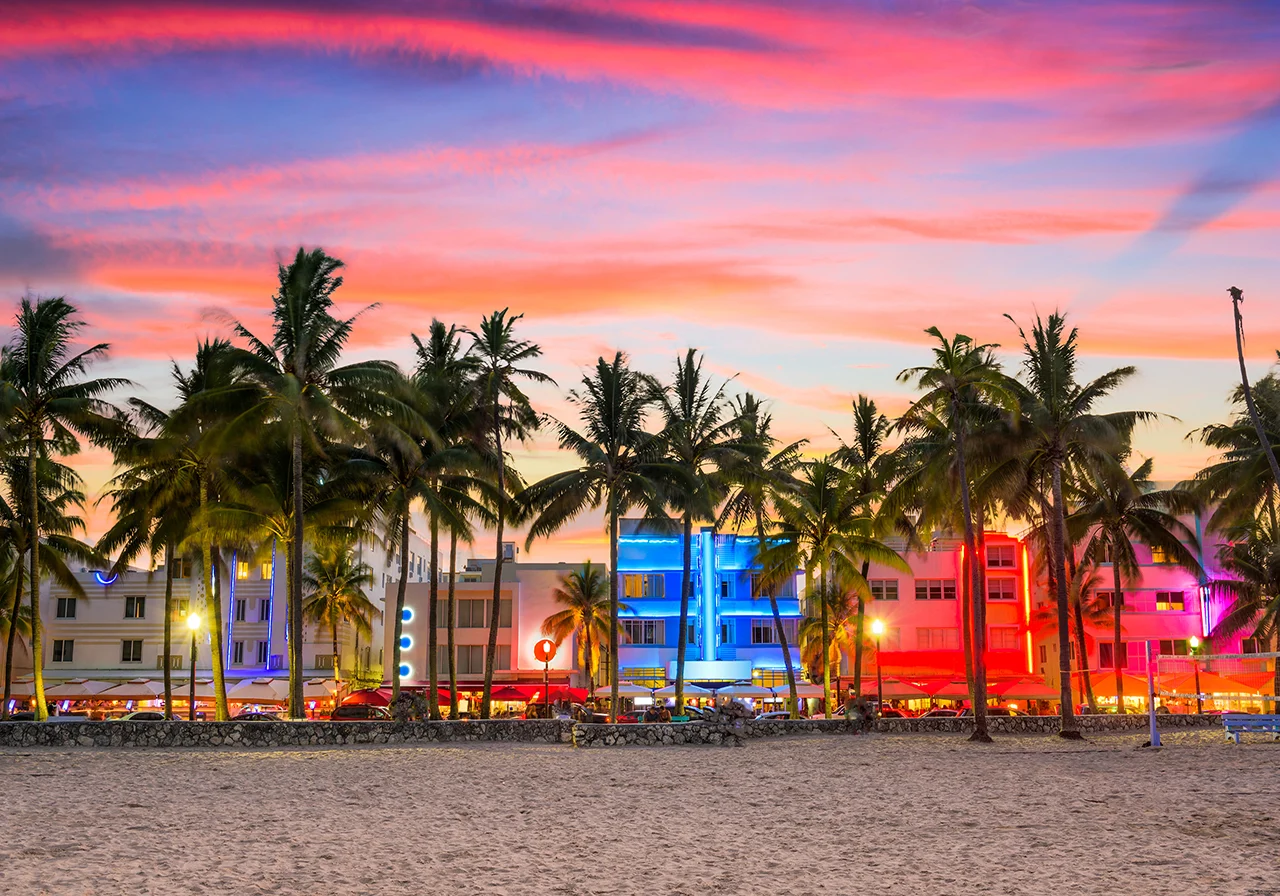
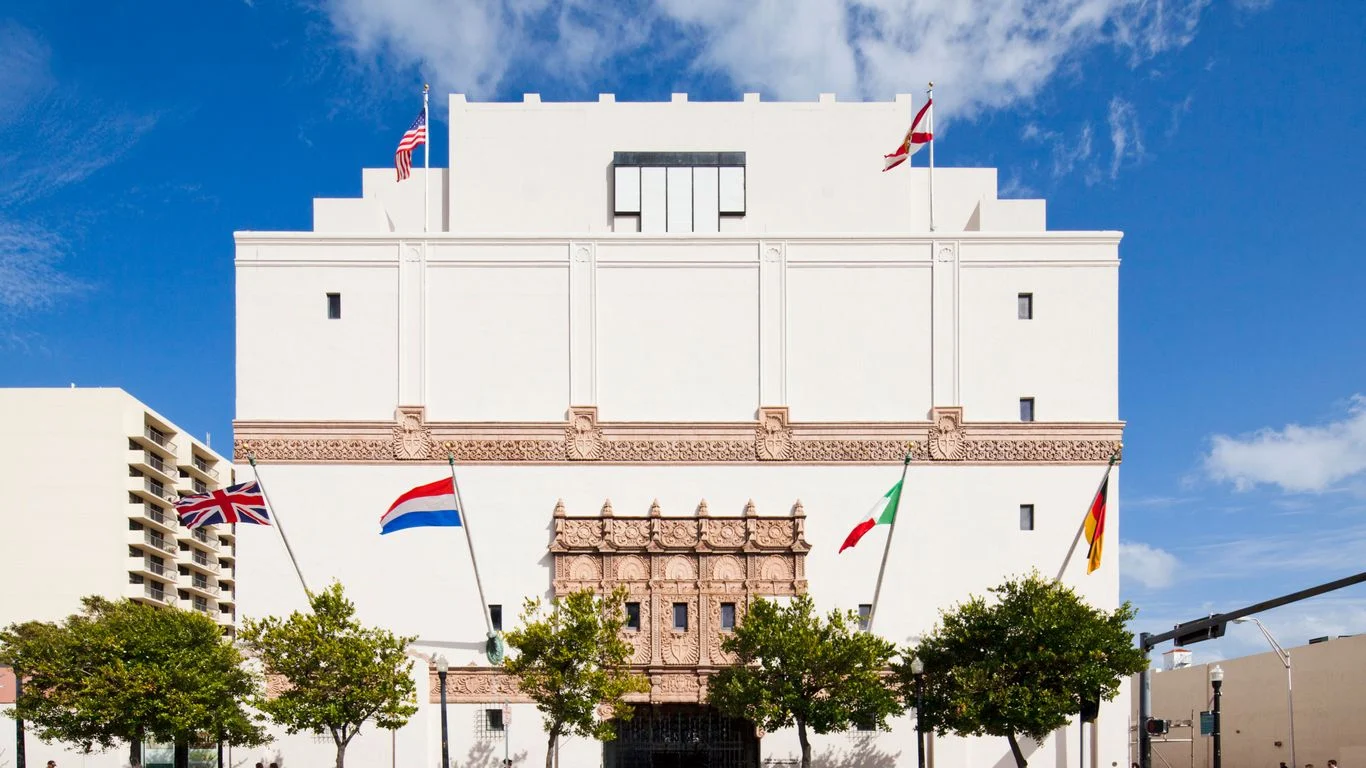
Top: Left: Avalon Hotel, 1941, Albert Anis, Middle: Breakwater Hotel, 1939, Anton Skislewicz, Right: Ocean Drive, Miami Beach, at sunset, Bottom: Left: The Wolfsonian-FIU, 1927, Robertson & Patterson, Right: Colony Theatre, 1935
✕
ART & STATUES
CERAMICS & GLASS
Miami Beach, the Art Deco City by the Sea
Sunlight, Stucco, and the Rise of Tropical Deco
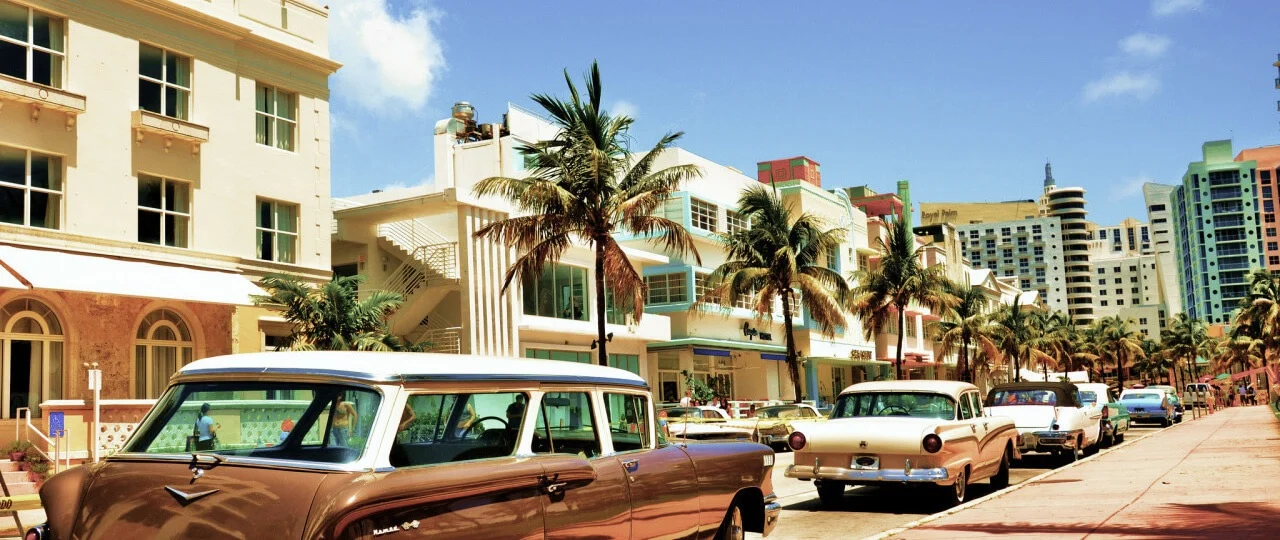
 Before it became one of the most photographed stretches of coastline in America, Miami Beach was a narrow, mosquito-plagued barrier island choked with mangroves, separated from the young city of Miami by a shallow bay. A Quaker farmer named John Collins tried to coax coconuts and then avocados from its sandy soil in the early 1900s, with limited success, while a pair of local businessmen, the Lummus brothers, eyed the same swampy ground and saw a resort town waiting to be built. It was the arrival of Carl Fisher, an Indiana automobile entrepreneur with a gift for spectacle, that turned the vision into infrastructure: Fisher financed the bridge that finally connected the island to the mainland, dredged fill from the bay floor, and began marketing a patch of reclaimed sand as a tropical playground for wealthy northerners. The town incorporated in 1915, and by the 1920s a genuine land boom was underway, fueled by promotional stunts and a national appetite for Florida sunshine.
That boom ended abruptly on September 18, 1926, when a hurricane with winds well over a hundred miles an hour tore through the region, killing hundreds of people and flattening much of what had been built. The Great Depression arrived a few years later, and Miami Beach looked less like a resort than a cautionary tale. Recovery came in the early 1930s, in an unexpected form: desperate property owners rebuilding cheaply and quickly with modest hotels for middle-class tourists rather than millionaires. Many of the new buyers and builders were Jewish, a group largely excluded from the earlier boom by the restricted ownership and “gentile clientele” signs common at hotels of that era; the Depression made that discrimination a luxury few could still afford. The architectural style they reached for, streamlined, symmetrical, and inexpensive to build, would define the neighborhood far more than anything built during the boom years before it.
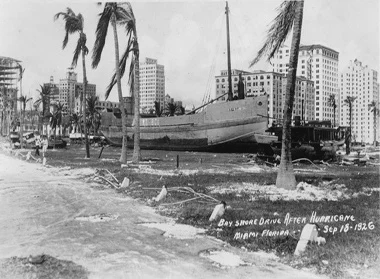
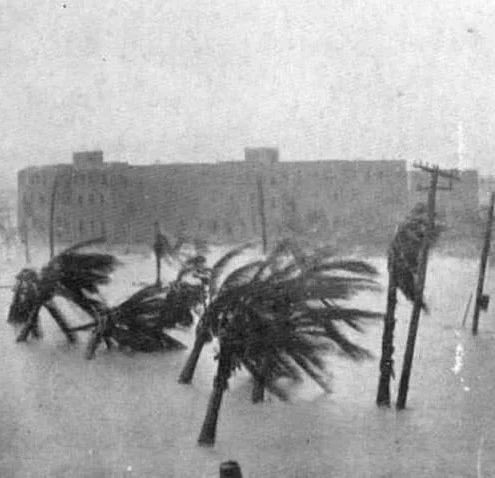

Left: Bayshore Drive, Miami, September 18, 1926, Middle: Great Miami Hurricane, September 18, 1926, Right: Ocean Drive and Lummus Park, late 1920s
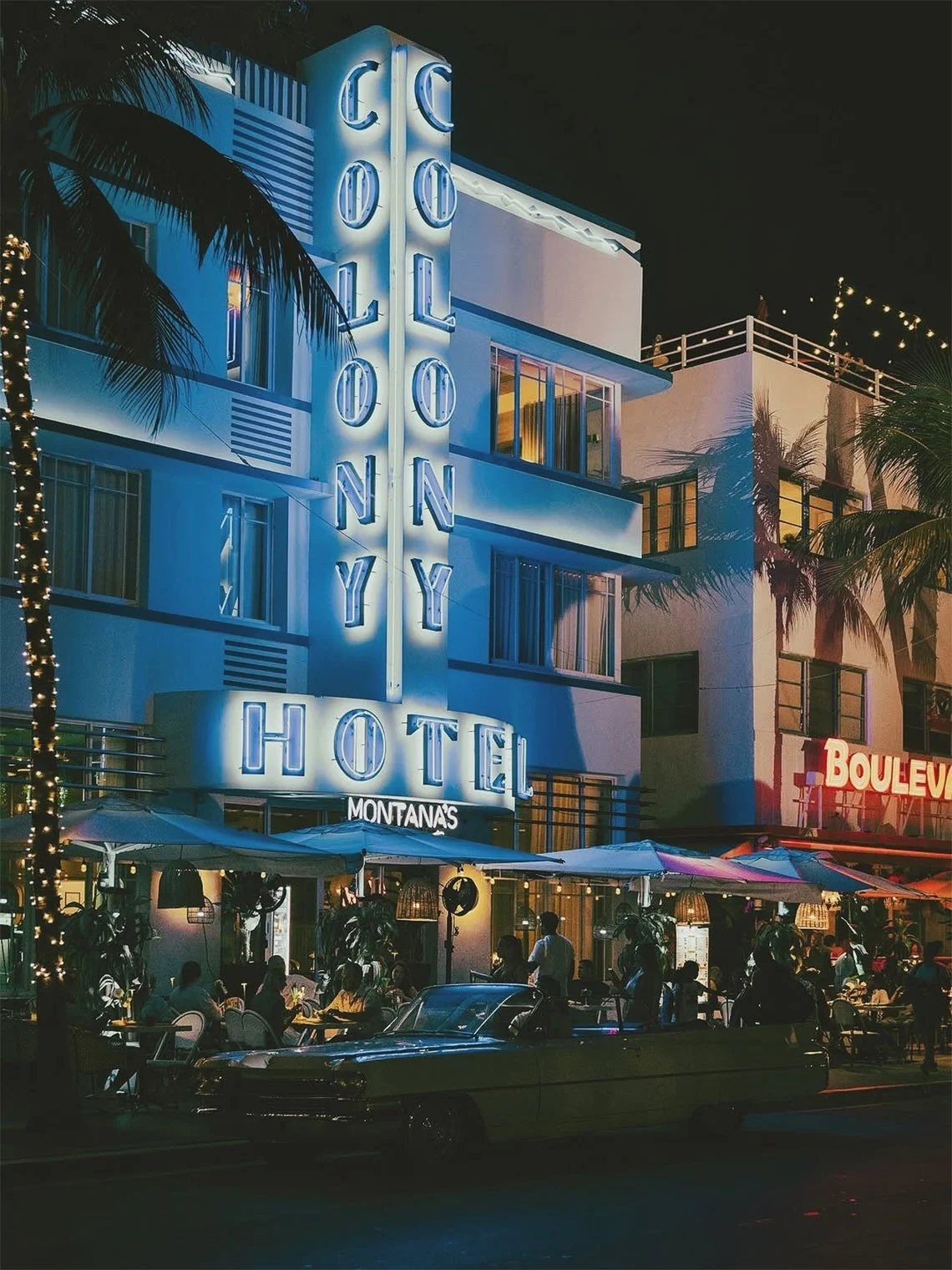 What survived and what came after is now known as the Miami Beach Art Deco Historic District, though most people simply call it the Art Deco District, or point to the neighborhood that contains it, South Beach. Roughly bounded by Ocean Drive, Collins Avenue, and Washington Avenue between 5th and 23rd Streets, the district holds more than eight hundred contributing buildings, the largest concentration of Art Deco architecture found anywhere in the world. On May 14, 1979, it was listed on the National Register of Historic Places, becoming the first twentieth-century urban district in the country to receive that designation, a remarkable distinction for a collection of buildings that were, at the time, barely forty years old. Most were built in a tight window between 1923 and 1943, which gives the district an unusual visual coherence: block after block of low-rise hotels and apartment houses, rarely taller than three or four stories, sharing a common architectural vocabulary even as each one competes for attention with its neighbors.
Walking it today feels less like touring a museum and more like stepping into a functioning neighborhood that happens to have kept its original wardrobe. Hotels still take guests, restaurants still fill their sidewalk tables, and the same buildings that once housed retirees on fixed incomes now anchor one of the most valuable stretches of real estate in Florida. That combination of architectural rarity and everyday use is part of what makes the district worth understanding rather than simply photographing. It is a rare case of an entire style surviving in place, in enough density and enough original context that a visitor can still read the ambitions of the people who built it: optimism after disaster, resourcefulness during hard times, and a distinctly local vision of what a modern resort should look like.
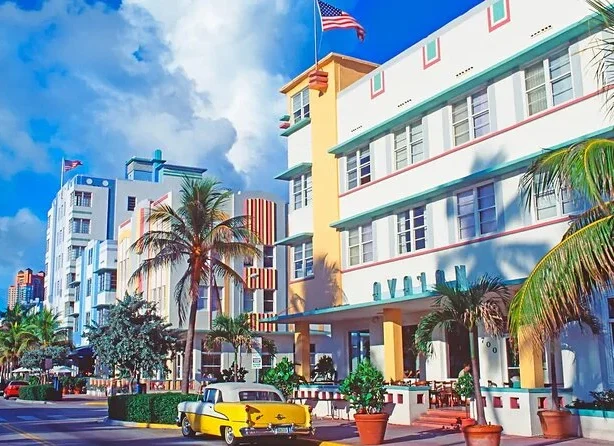
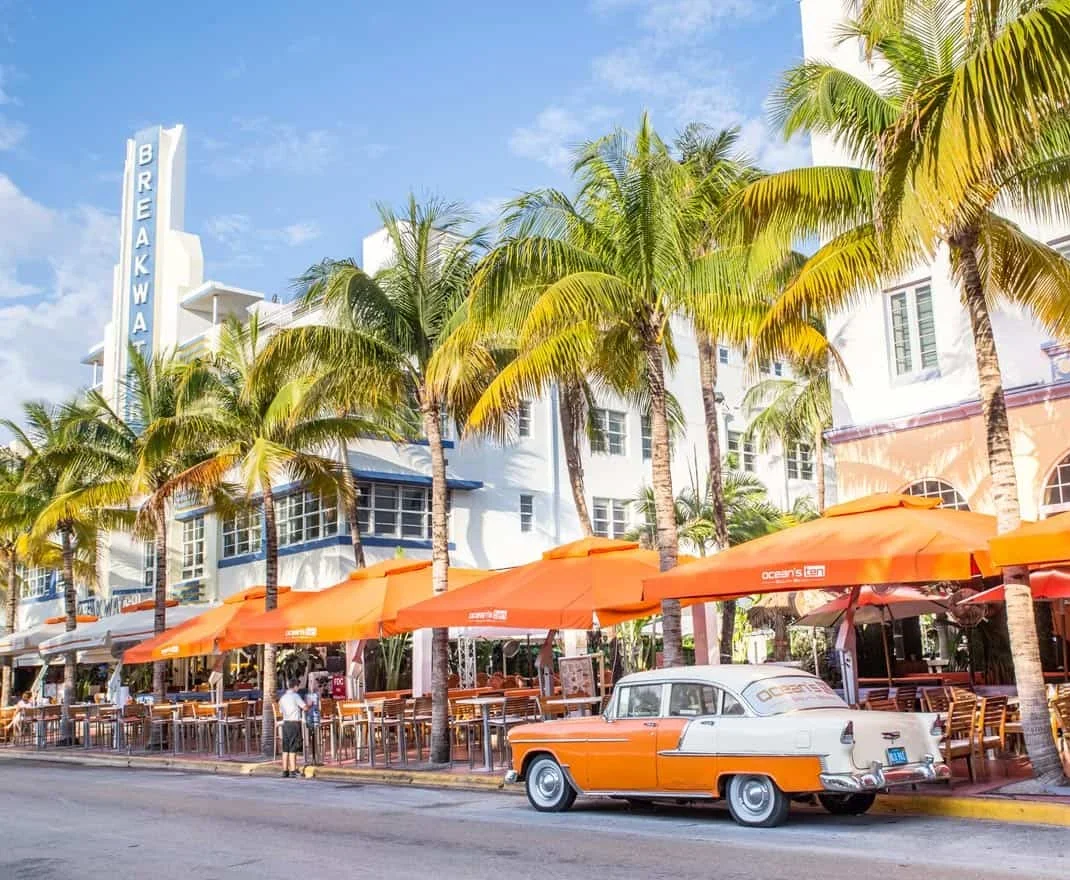
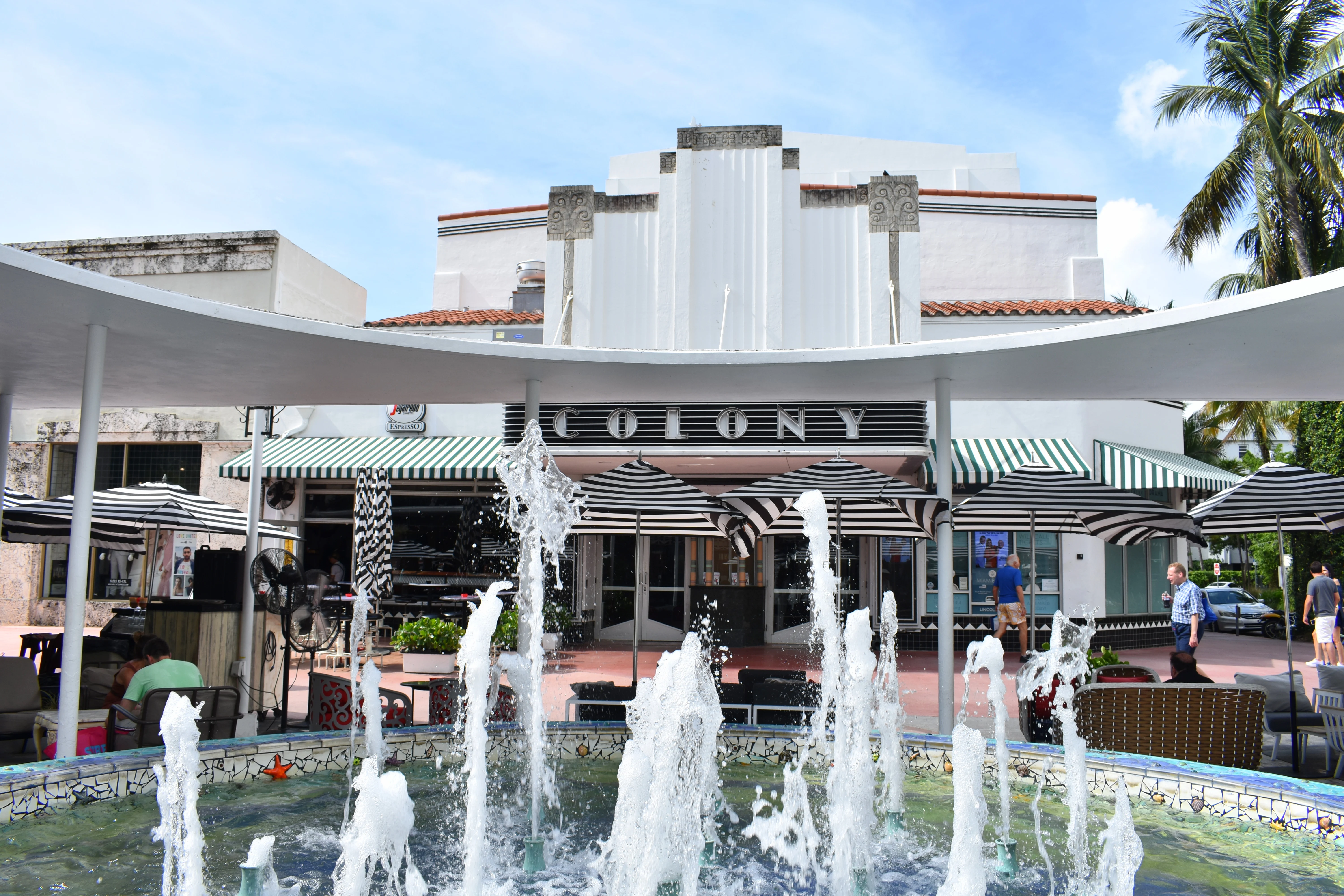
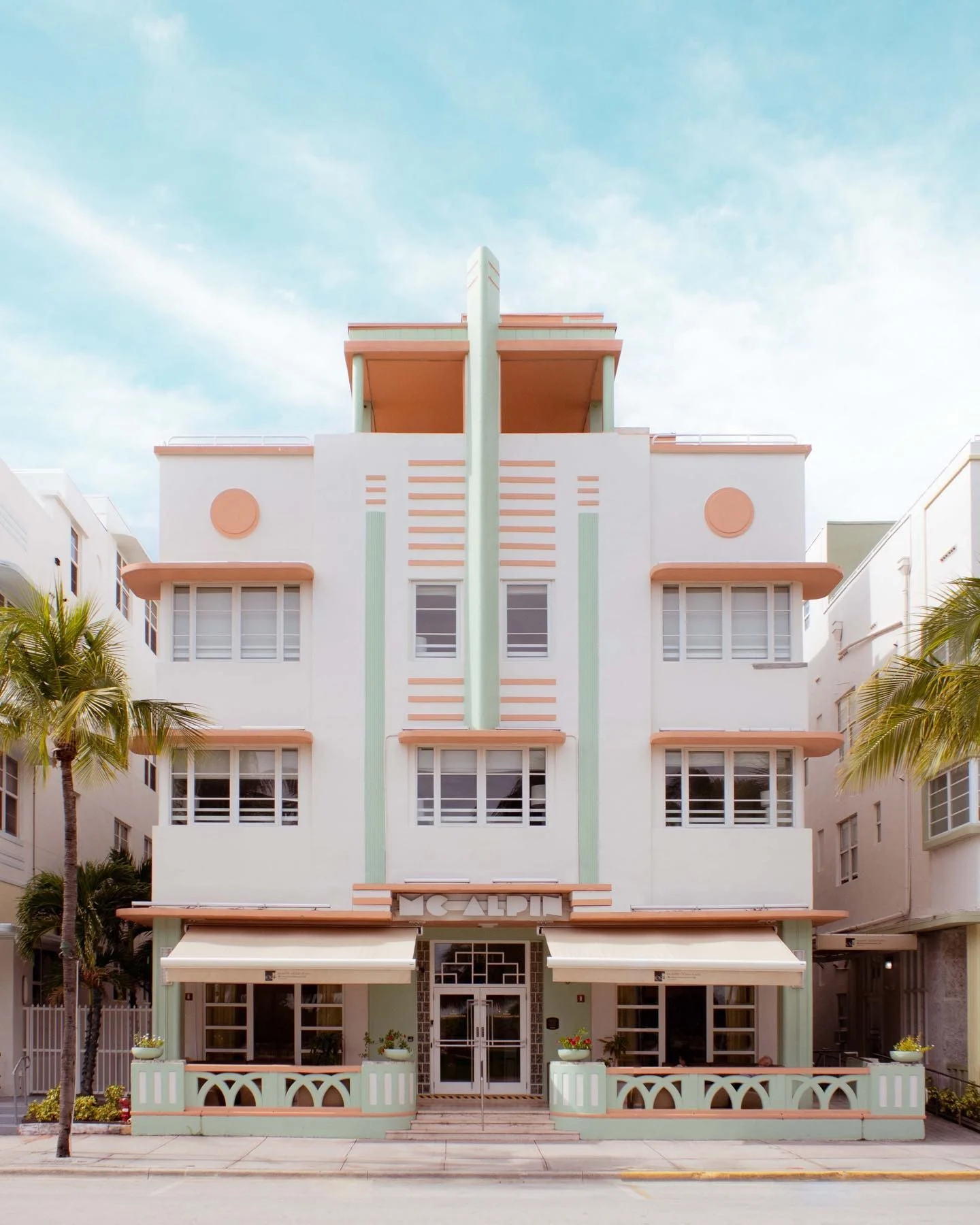 Architectural historians describe what happened next as a regional dialect of a larger international style. Art Deco elsewhere, in New York or Chicago or Paris, tended toward dark stone, chrome, and dramatic verticality. Miami Beach’s architects, working with tight budgets and a subtropical climate, translated the geometric vocabulary into something lower, lighter, and better suited to sun and salt air. Buildings stayed short, rarely more than three stories, with deep-set windows shaded by cantilevered concrete “eyebrows” and walls finished in cheap, paintable stucco instead of stone. Corners curved instead of meeting at sharp angles, echoing the aerodynamic look then fashionable in cars and trains. Inside, terrazzo floors and vertical signage typefaces gave hotel lobbies the same symmetrical rhythm as the facades outside, elements grouped in threes, none of it accidental.
The decoration layered on top of that form drew from two sources, and architects were happy to mix them. The first was the sea itself: round porthole windows, chrome railings borrowed from ship decks, and rounded corners echoing a vessel’s prow, all pointing back to the golden age of transatlantic ocean liners. The Essex House takes the metaphor furthest, its corner cut to a point below a tower topped with a smokestack-like sign. The second source was the local landscape, with palm fronds, flamingos, and other Florida motifs worked into relief carvings and terrazzo floors. Both sat on top of a broader style Miami Beach did not invent. Art Deco had announced itself at the 1925 Paris exposition, already carrying borrowed influences from Mayan stepped pyramids, Egyptian motifs revived after the 1922 discovery of Tutankhamun’s tomb, and the fractured geometry of Cubist painting. Where Deco elsewhere leaned dark and dramatic, South Beach took that same underlying grammar, the zigzags, the sunbursts, the streamlined curves, and rendered it in pastel stucco under a subtropical sun.
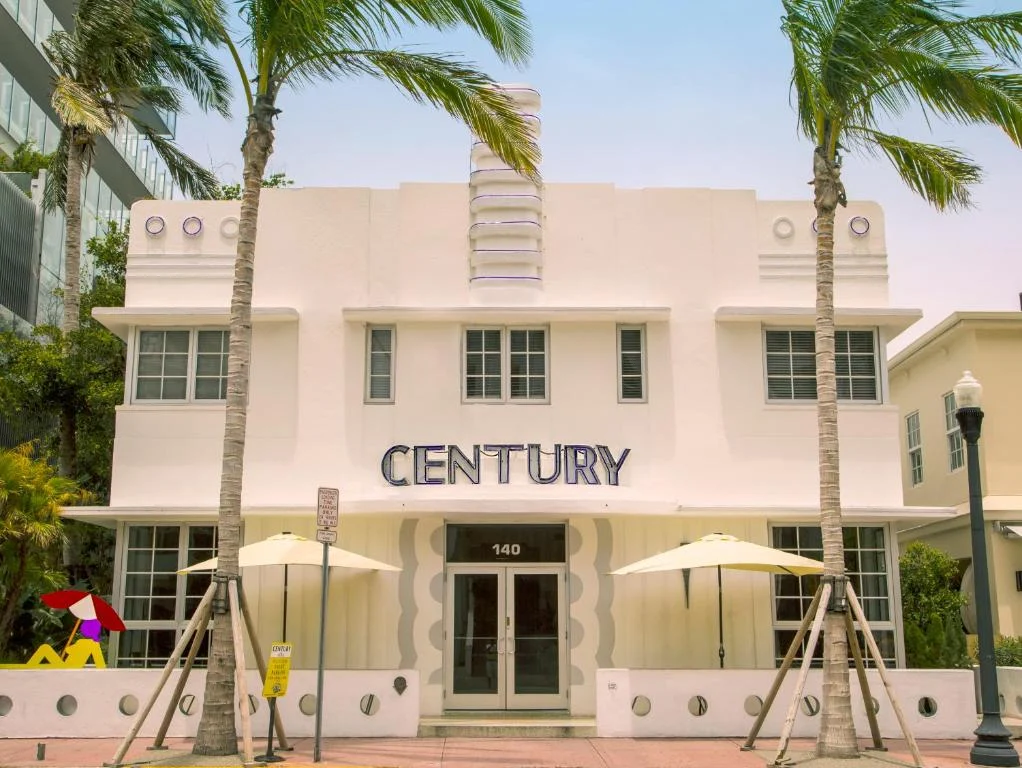
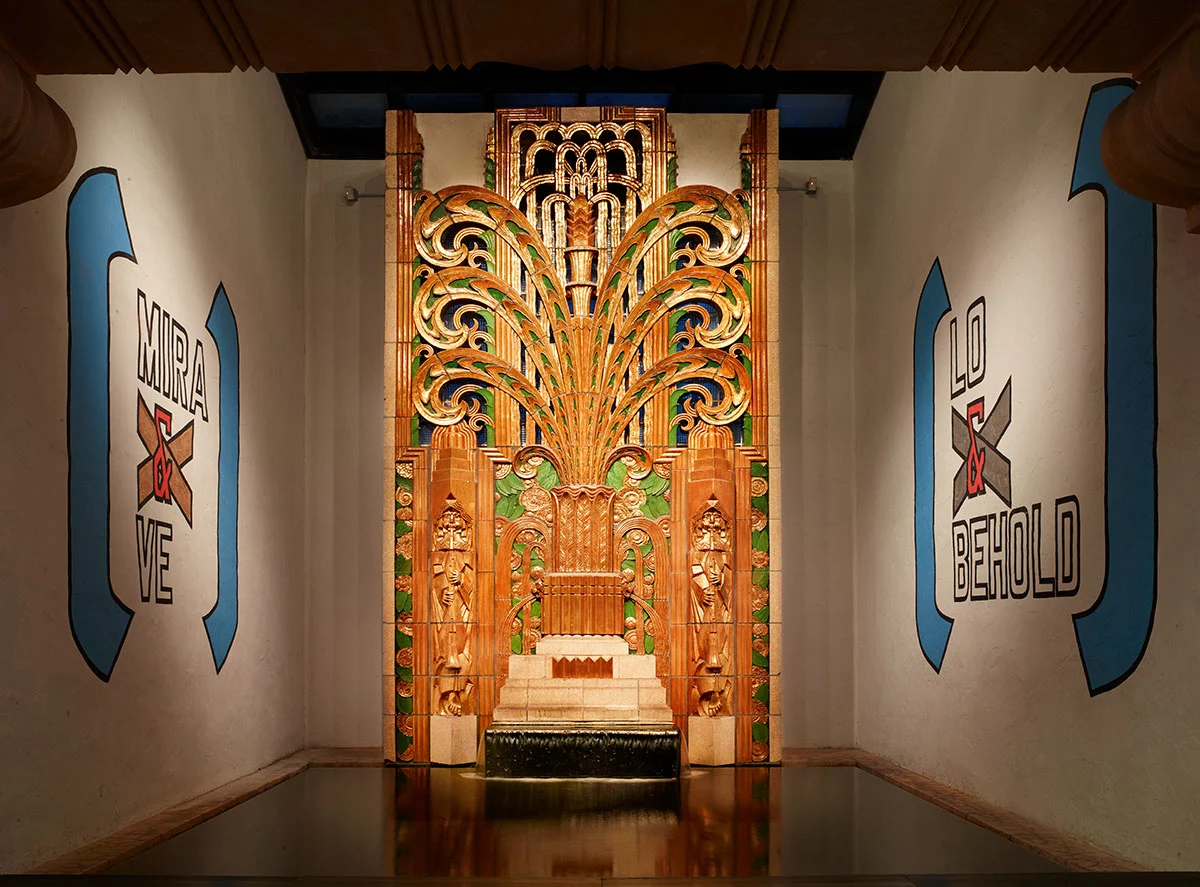
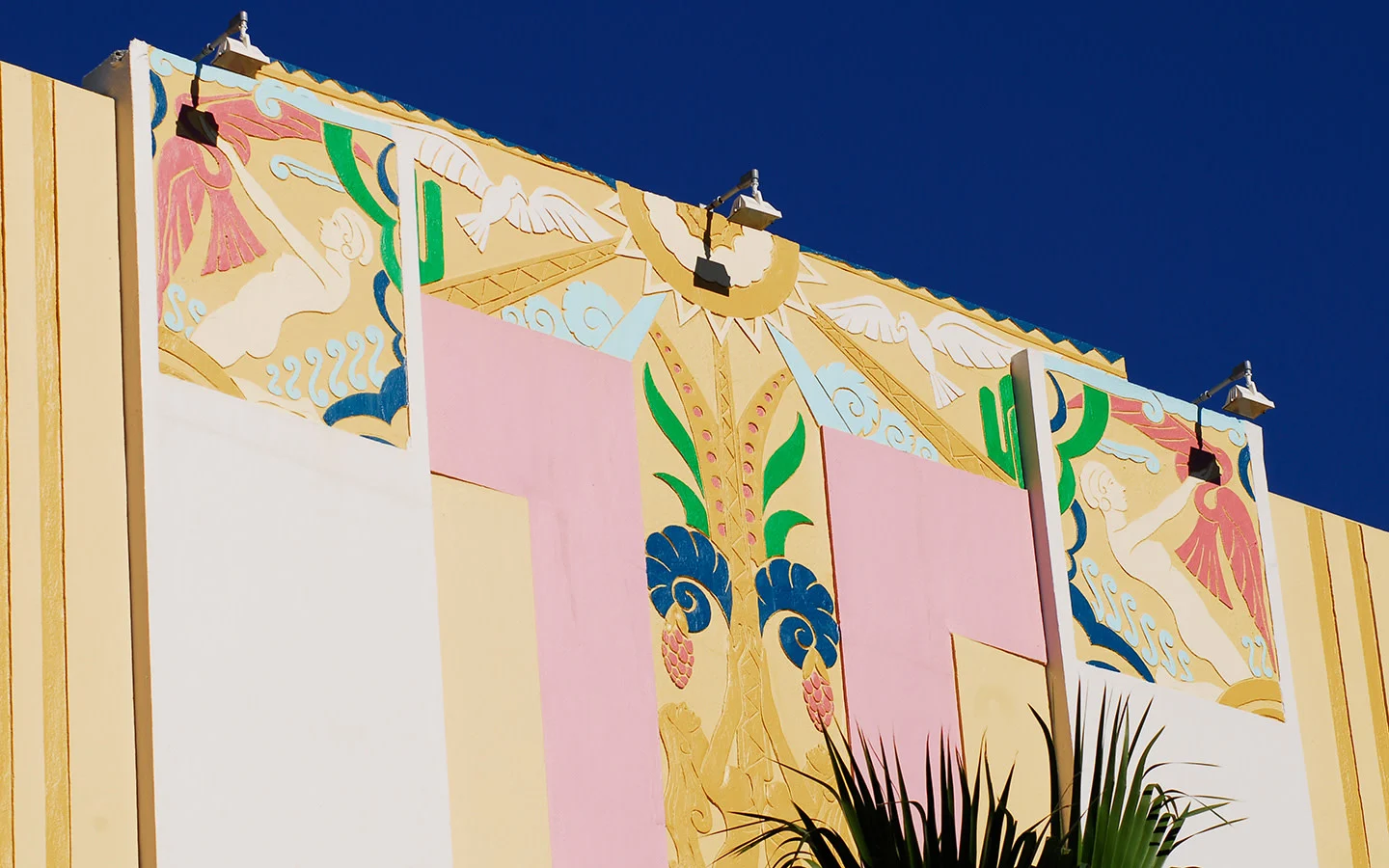
Top: Left: Century Hotel, 1939, Henry Hohauser, Right: “Frozen Fountain” relief, Wolfsonian-FIU Museum, Bottom: Architectural relief detail
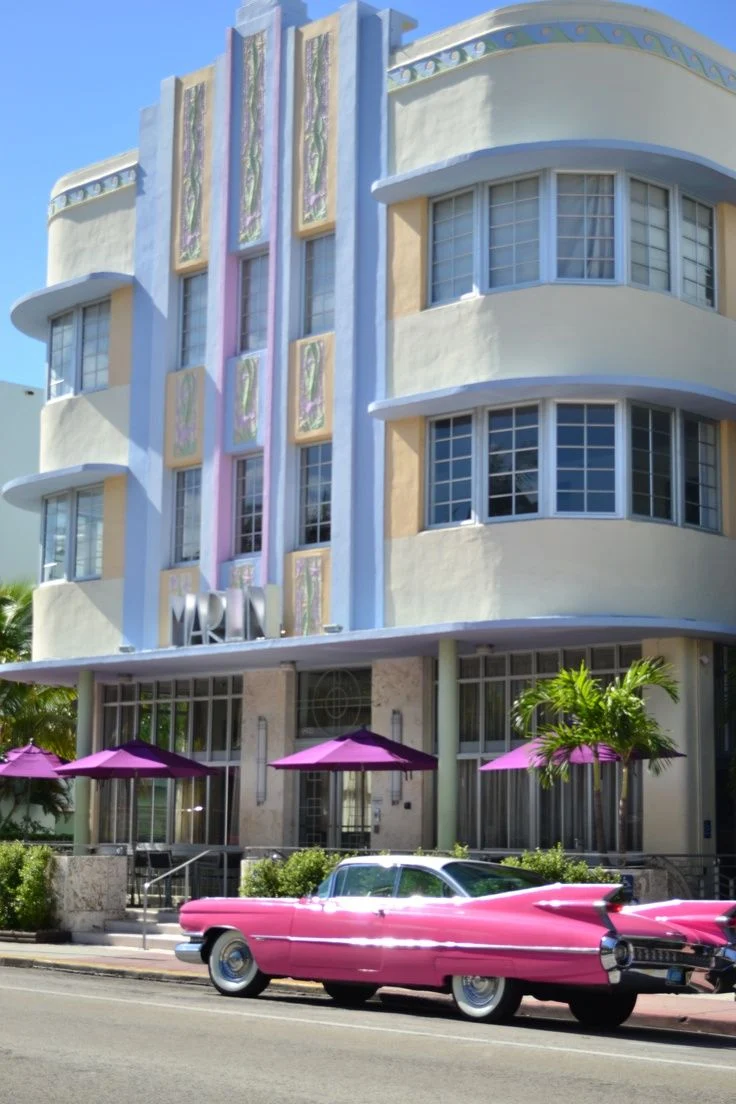 Two names come up more than any others in the story of these buildings: Henry Hohauser and L. Murray Dixon. Both were New Yorkers who had relocated to South Florida in the early 1930s, and together they are credited with designing a large share of the district’s original buildings. Hohauser, who trained at the Pratt Institute before moving to Miami in 1932, designed the Colony Hotel on Ocean Drive in 1935, generally considered the first fully streamlined building on the strip and an early sign of where the neighborhood was headed. He went on to design hundreds of buildings over the following decade, including the Park Central and the Cardozo, working quickly and affordably for developers who needed rooms filled by the following winter season.
Dixon, meanwhile, built the Tides, the Marlin, the Tiffany, and dozens of others along Collins Avenue, developing a reputation for curved, almost sculptural facades. A third architect, Albert Anis, rounded out the trio most associated with the district’s golden years. What united them was less a shared philosophy than a shared set of constraints: modest budgets, a compressed timeline, and a clientele of middle-class vacationers rather than the industrialists who had financed Carl Fisher’s earlier, far grander hotels like the Flamingo. Those constraints turned out to be generative. Working small and fast, this loose community of architects filled block after block with buildings that talked to each other, matching cornice heights and echoing color and massing, until Ocean Drive read less like a collection of individual commissions and more like a single, continuous composition. It is that cohesion, as much as any one building, that gives the district its distinctive character today.

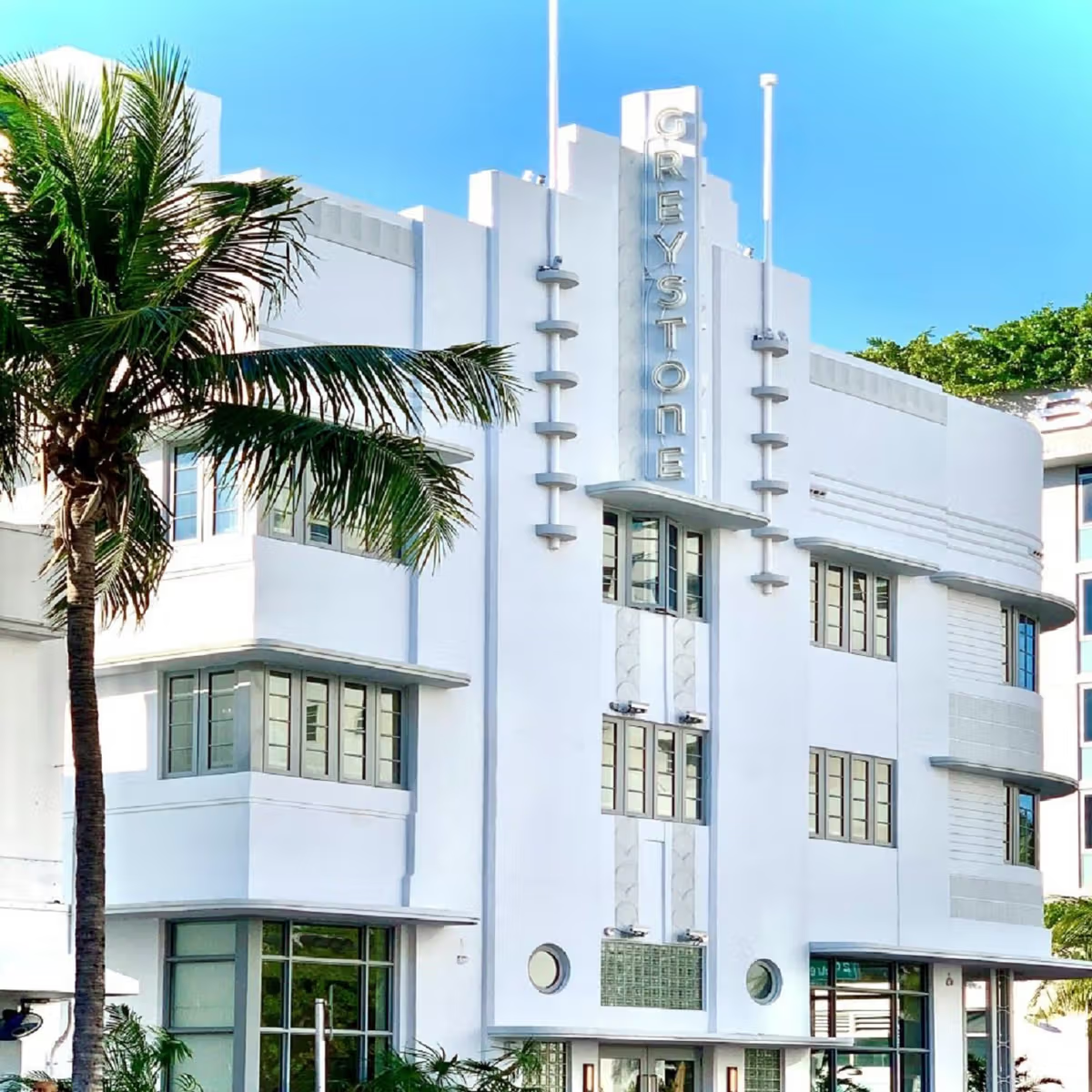
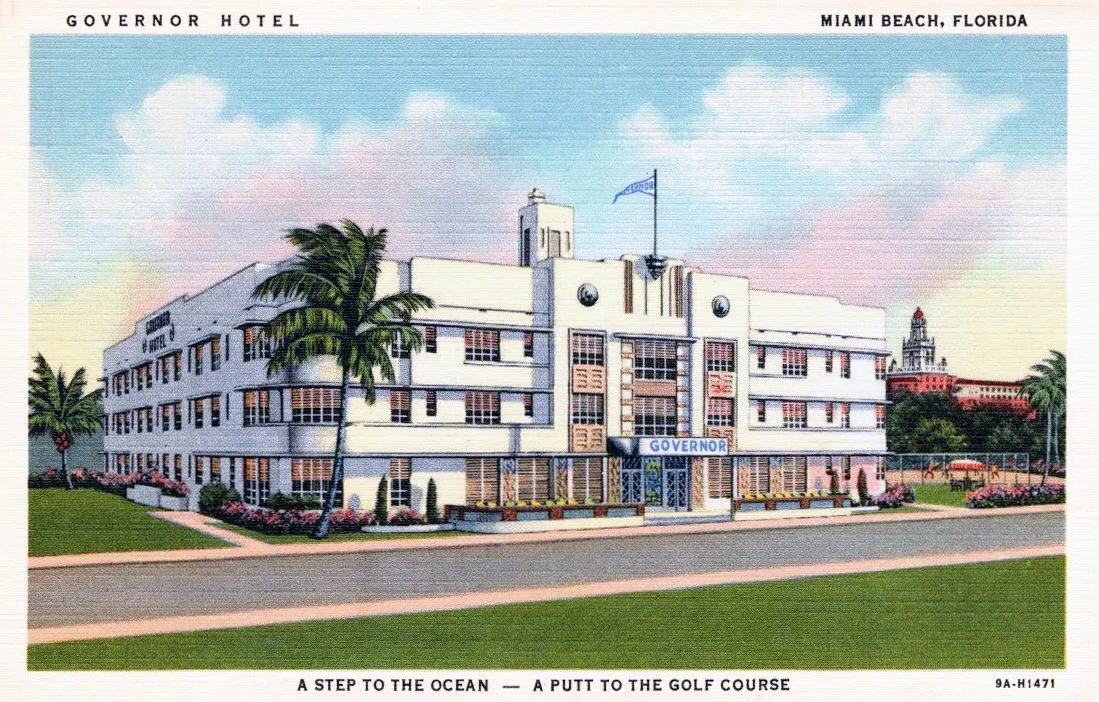
Top: Left: Congress Hotel, 1936, Henry Hohauser, Right: Greystone Hotel, 1939, Henry Hohauser, Bottom: Governor Hotel, 1939, Henry Hohauser, vintage postcard
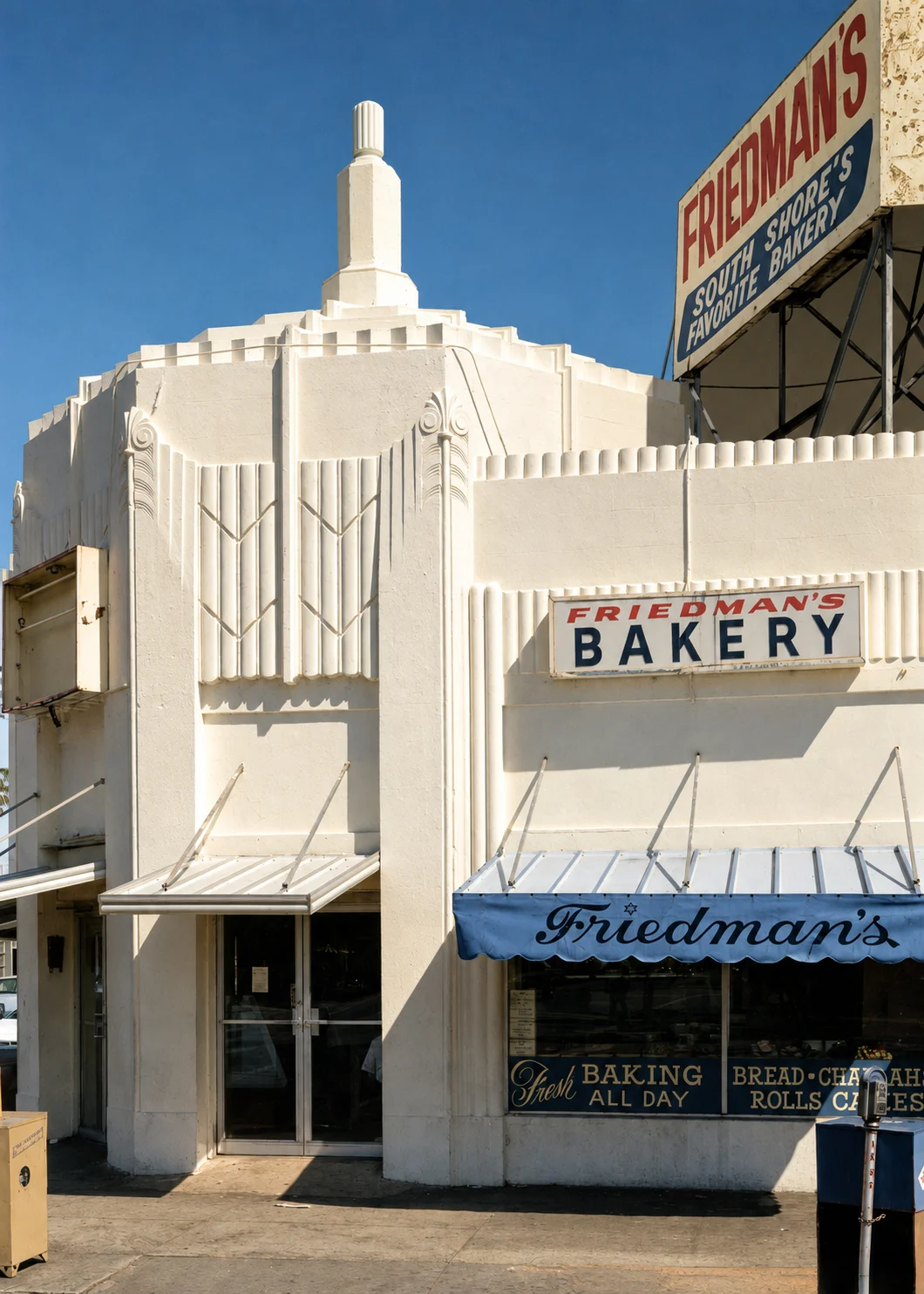 One detail surprises almost everyone who learns it: the pastel palette now considered inseparable from the district’s identity was not part of the original design. Photographs from the 1930s and 1940s show a neighborhood dressed mostly in white, cream, and the occasional muted accent, colors chosen to reflect heat rather than announce a mood. By the 1970s, decades of salt air and deferred maintenance had faded even that restrained palette into a uniform, dispirited gray. The transformation came from a New York-trained designer named Leonard Horowitz, who had settled in Miami Beach and began working alongside preservationist Barbara Baer Capitman to save the neighborhood he had come to love.
In the early 1980s, Horowitz assembled a palette of roughly forty colors, explaining that he had pulled them straight from the local environment: the way the sky looks at sunrise and sunset, the changing color of the ocean across the seasons, even the sand, which he remembered as a richer gold in earlier decades. He tested the palette first on Friedman’s Bakery, a modest building on Washington Avenue, and the reaction was not immediately favorable. Longtime residents found the new colors jarring against buildings they associated with plainer decades. That changed quickly once the repainted bakery landed on the cover of a national architecture magazine in 1982, well before Miami Vice brought the same palette to television screens worldwide two years later. What had begun as a preservation strategy, color as a way of drawing attention to buildings that might otherwise be demolished for their land, became the visual shorthand for an entire city. The pastels were never in the original blueprints, but it is difficult now to imagine the district without them.
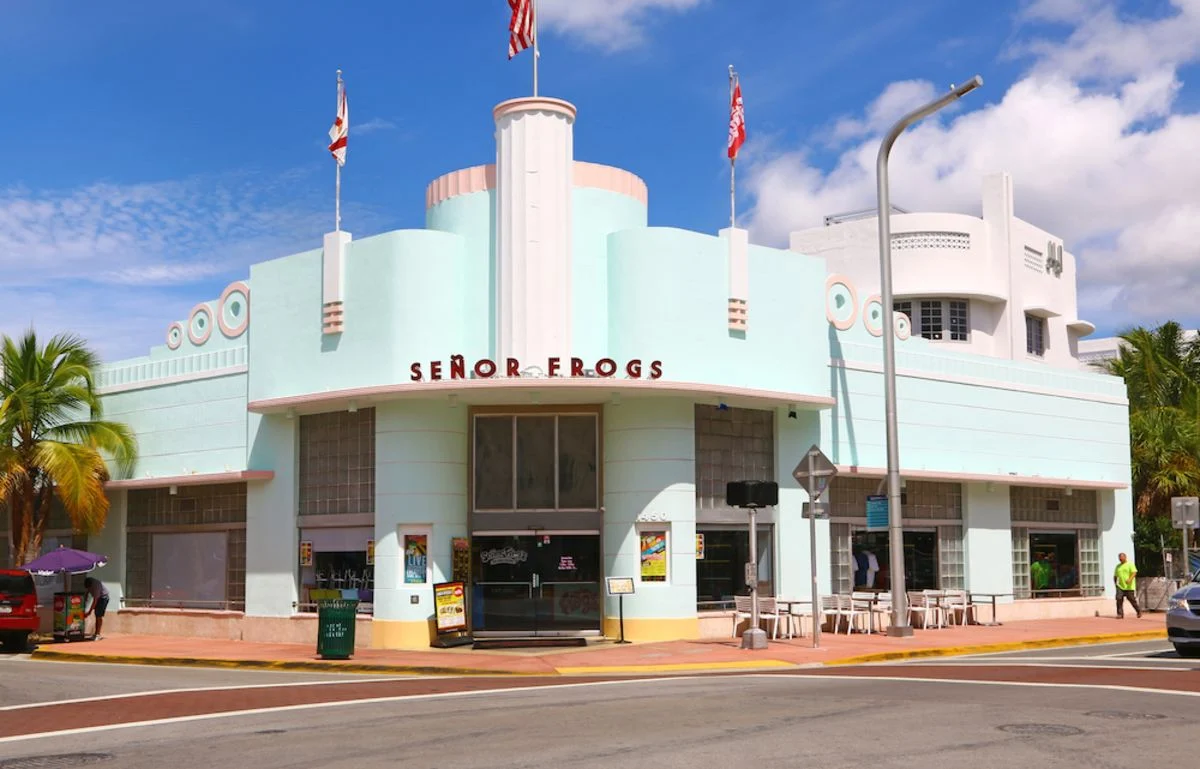
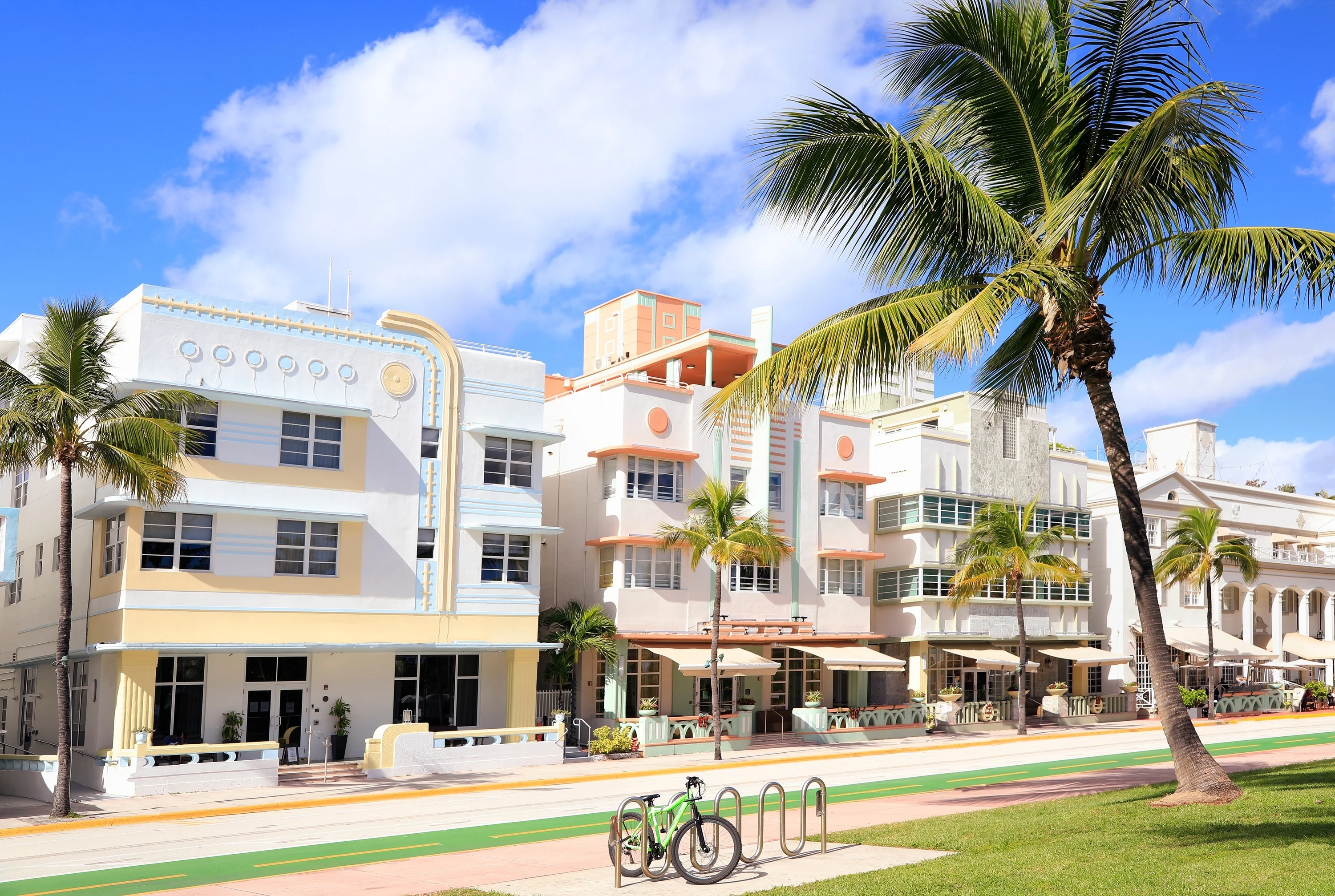

Top: Left: 1450 Collins Avenue, 1940, Henry Hohauser, Right: Leslie and McAlpin Hotels, Bottom: Delano Hotel, 1947, B. Robert Swartburg, beachfront
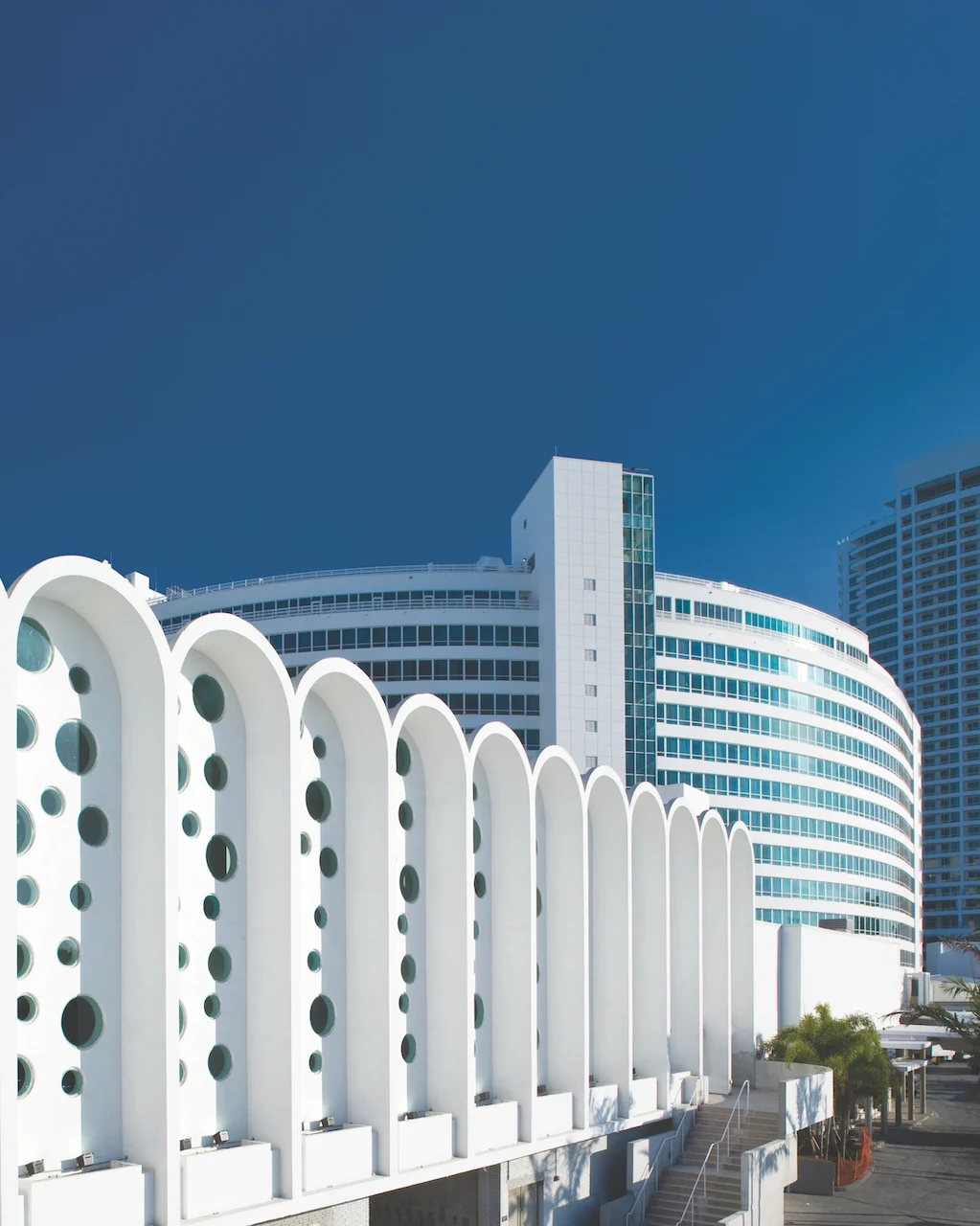 The neighborhood’s fortunes did not hold. After the Second World War, Miami Beach’s newer, flashier hotels went up further north in Mid-Beach, chasing a wealthier clientele with pools and modern amenities the old Deco buildings simply could not offer. Morris Lapidus’s Fontainebleau, all sweeping curves and grand staircases, opened there in 1954, the new face of Miami Beach glamour in a look later nicknamed MiMo, for Miami Modern. Its cat-shaped pool became one of the era’s most photographed, and when the neighboring Eden Roc drew away too many of the same guests, Fontainebleau’s owner had a windowless tower built specifically to shadow its rival’s pool deck each afternoon. Next to that spectacle, the modest three-story hotels further south looked dated almost overnight. South Beach itself became a much quieter, retiree-heavy neighborhood, many of its residents Holocaust survivors and former New Yorkers; by the 1970s the two-square-mile enclave was roughly eighty percent Jewish, one of the most concentrated Jewish communities in the country, its daily rhythm built around Lincoln Road’s shops and delis like Junior’s. Maintenance slowed, then stopped almost entirely in some buildings.
By the 1960s, the neighborhood that had once represented the height of architectural fashion looked tired and forgotten, its buildings dismissed by many locals as outdated relics rather than anything worth saving. Developers took note of the low property values and the ocean frontage and began proposing exactly what had happened elsewhere along the Florida coast: demolish the old low-rise buildings and replace them with taller, more profitable towers. Through the early 1970s, this looked like the neighborhood’s likely future. Zoning favored redevelopment, city leadership showed little interest in the aging hotels, and a number of buildings were in fact torn down before anyone organized to stop it. What the district needed was someone willing to argue that these unfashionable, unglamorous buildings, still not even fifty years old and therefore too young by conventional standards to be considered historic, were worth fighting for anyway. That argument would take real persistence to make, and for most of the decade it was far from clear that it would succeed.

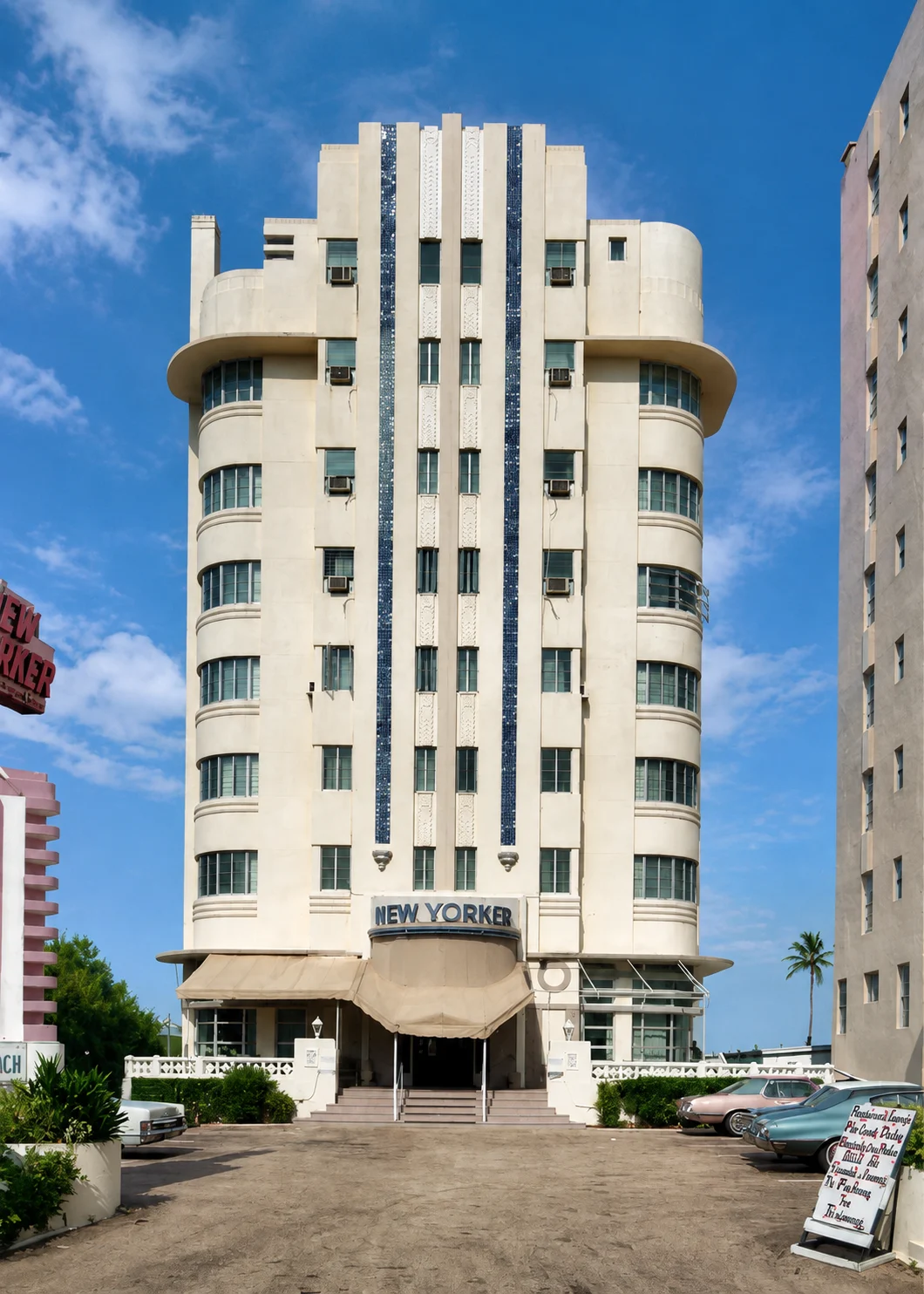
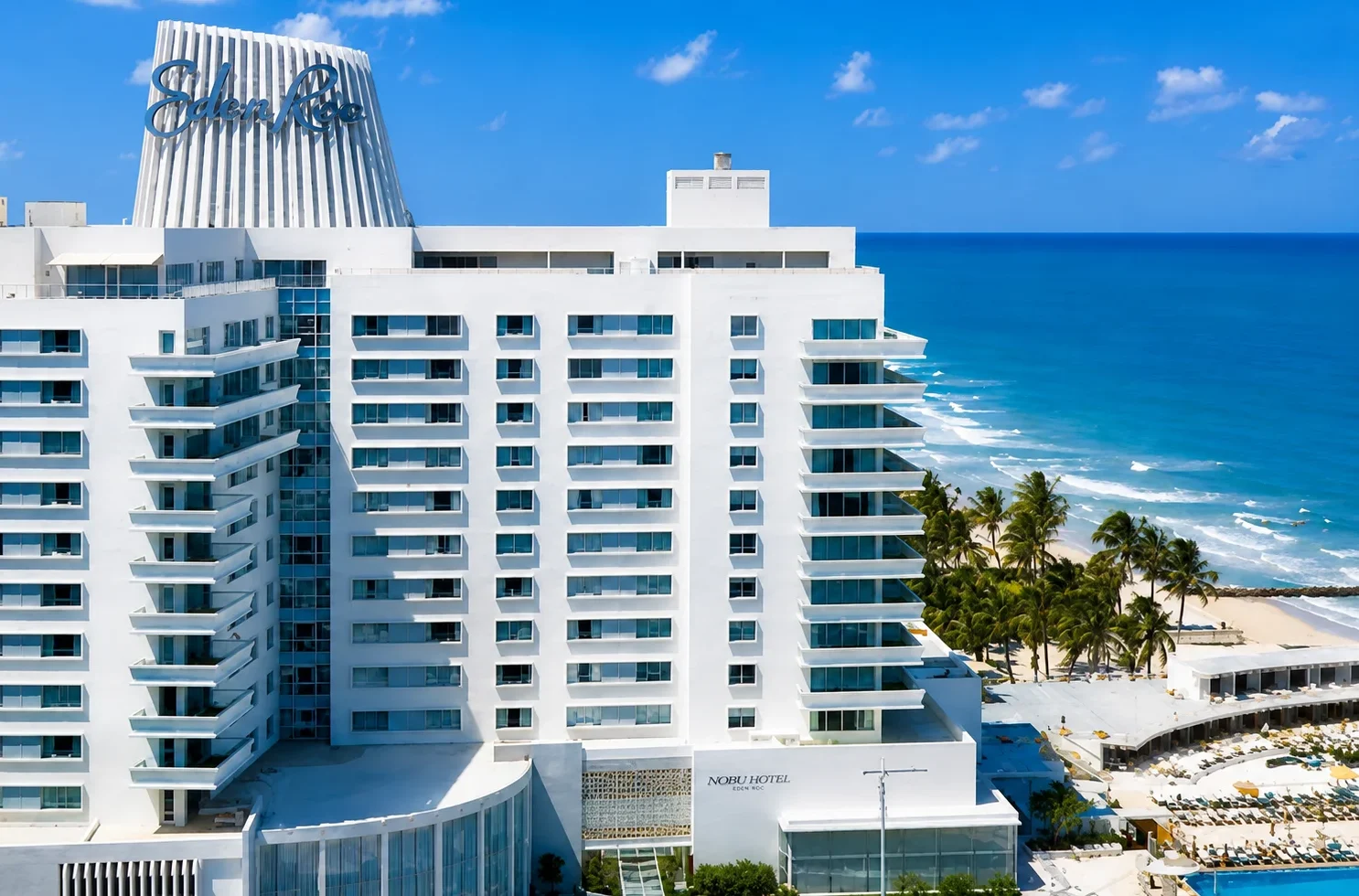
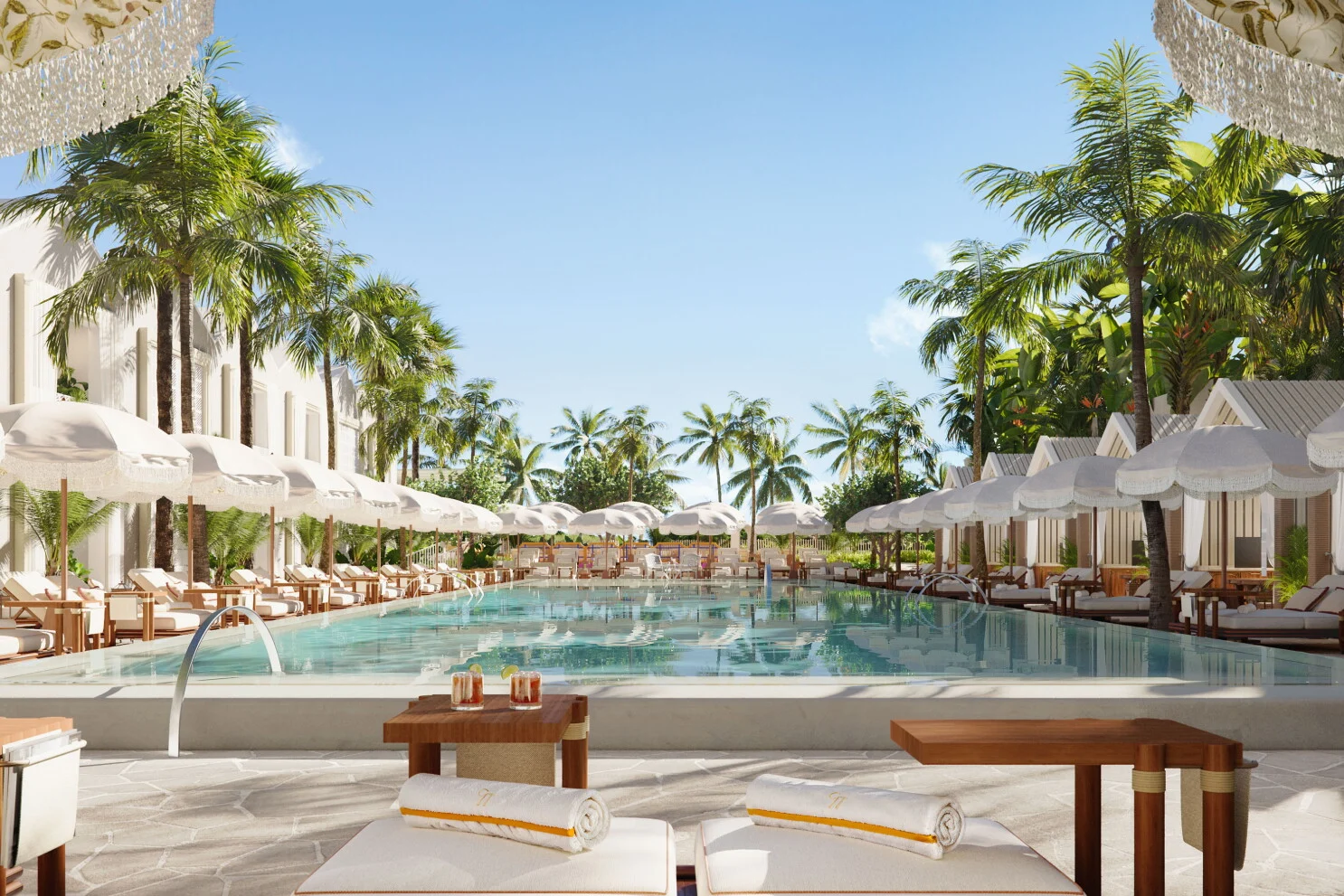
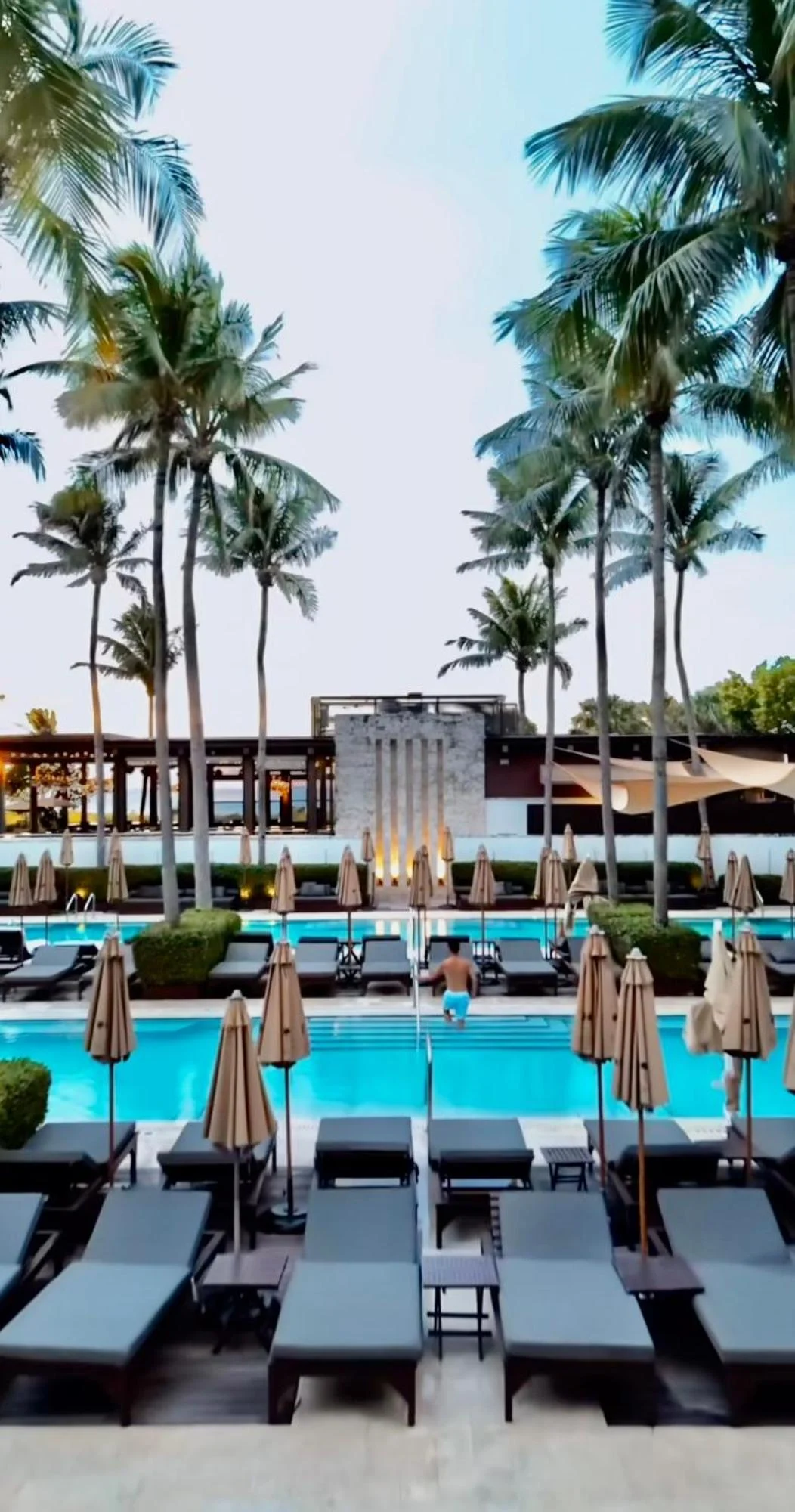

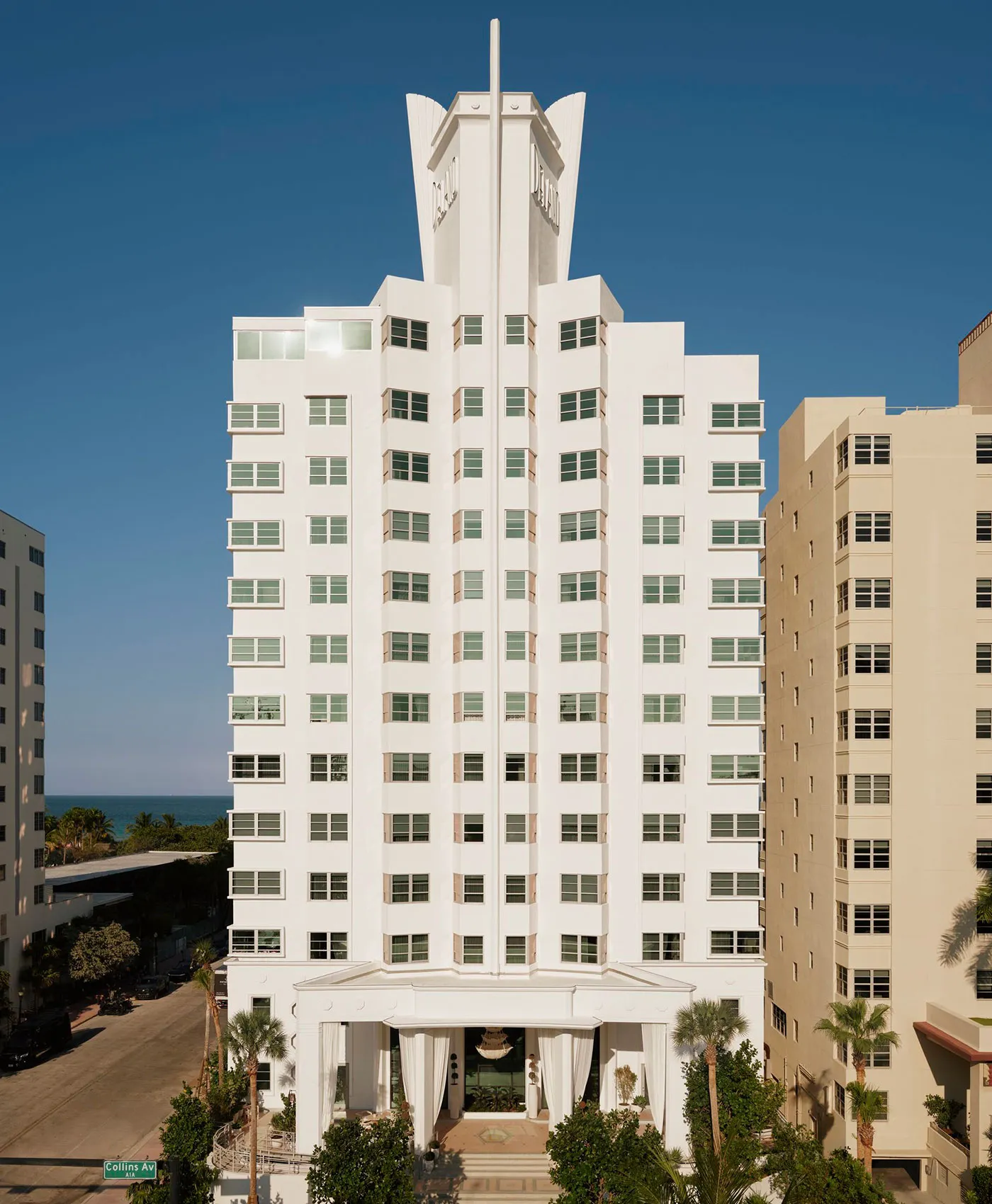
Top: Left: Senator Hotel, 1939, L. Murray Dixon, demolished 1988, Middle: New Yorker Hotel, 1939, Henry Hohauser, demolished 1981, Right: Eden Roc, 1956, Morris Lapidus, Bottom: Left: Delano Hotel, 1947, restored in 2026, Middle: The Setai, formerly the Dempsey-Vanderbilt, 1937, Henry Hohauser, Right: Grand Beach Hotel, 2009
 That persistence arrived in the form of Barbara Baer Capitman, a writer and activist who moved to Miami Beach with her husband in 1973 and found herself captivated by the very buildings her neighbors wanted torn down. Working with designer Leonard Horowitz and a small circle of like-minded residents, Capitman founded the Miami Design Preservation League in 1976, initially conceived as a modest bicentennial project: walk the neighborhood, photograph what was still standing, and document its thirties-era architecture before developers could finish tearing it down. Documentation quickly turned into advocacy.
Capitman argued, against considerable local skepticism, that a collection of buildings barely half a century old could still qualify as historically significant, and at a state hearing in December 1978 she made the case for a district covering roughly twelve hundred structures. The opposition was substantial: developers, some city officials, and residents who saw far more value in the land than in the buildings sitting on it. Despite that resistance, on May 14, 1979, roughly eight hundred of those buildings were formally listed on the National Register of Historic Places as the Miami Beach Architectural District, the first urban district composed entirely of twentieth-century buildings to receive that designation anywhere in the country. The listing carried no automatic legal protection against demolition, and the fight over individual buildings continued for years afterward, at times with Capitman and her allies physically positioning themselves in front of construction equipment. But the designation gave the preservation movement something it had lacked: legitimacy, a formal record, and a foothold from which to keep arguing that this stretch of beachfront deserved a future as well as a past.

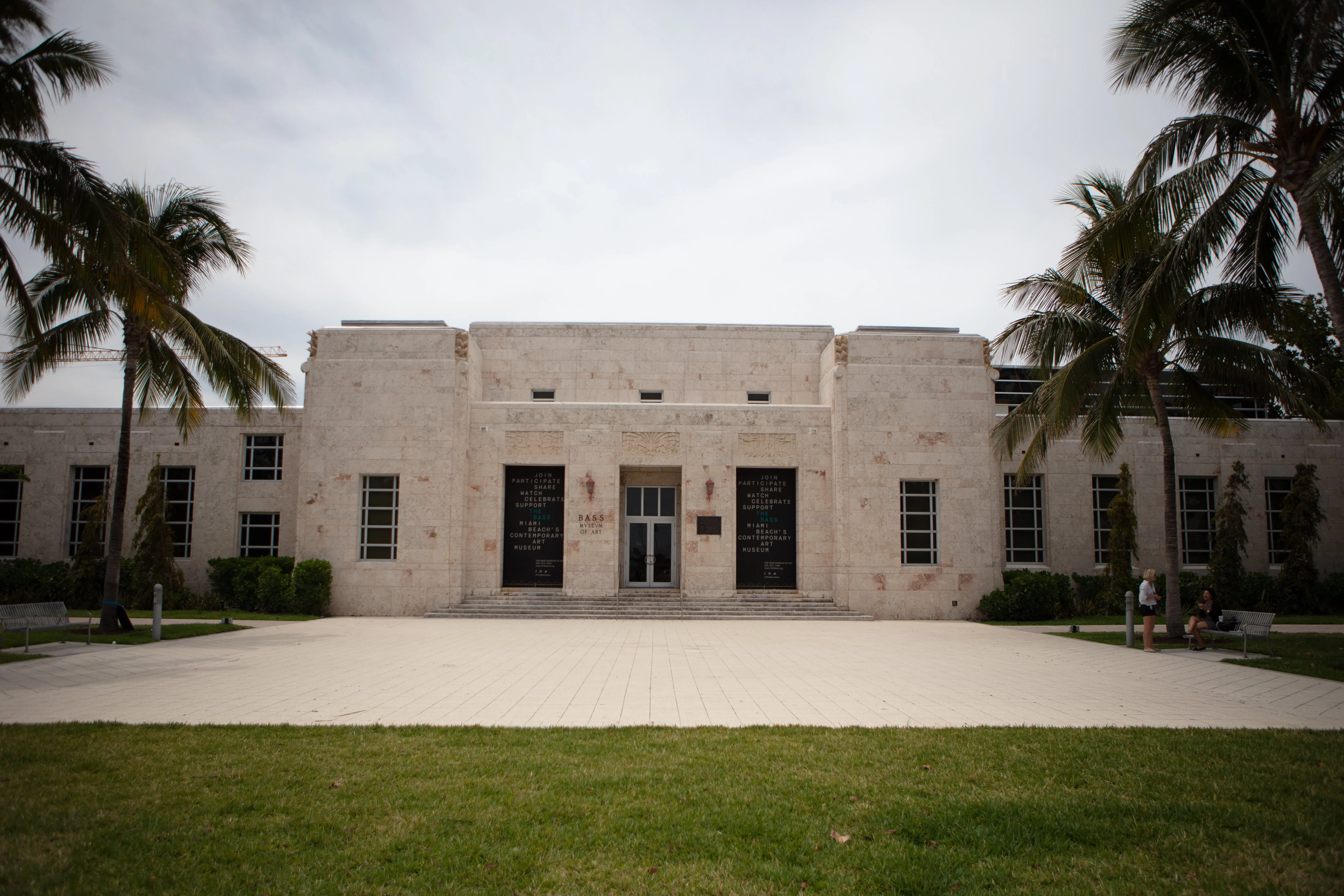
Left: Cardozo Hotel, 1939, Henry Hohauser, Right: The Bass, 1930-1934, Russell Pancoast
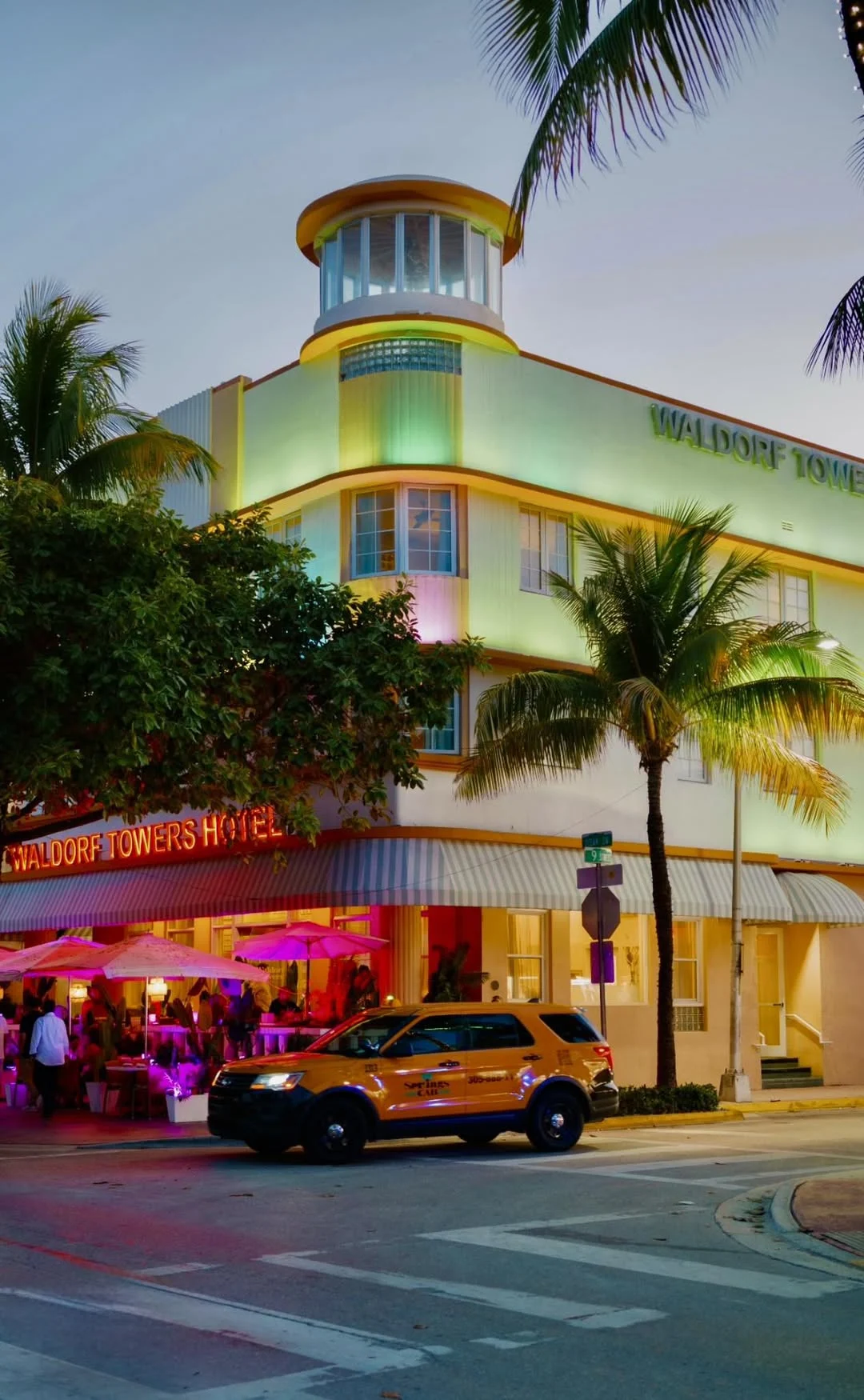 Legitimacy did not immediately translate into investment, and Ocean Drive stayed run-down for several more years. That began to change in 1985, when developer Tony Goldman drove down the street for the first time and, by his own account, fell in love with it on sight, going on to restore close to twenty buildings including Hohauser’s Park Central and Dixon’s Tiffany Hotel. Fashion photographers followed, drawn to the pastel facades as a backdrop, and television followed the same instinct: when Miami Vice premiered in 1984, its neon-lit location shots carried South Beach to a national audience every week. Locals widened Ocean Drive’s sidewalks with a three-million-dollar bond measure, and sidewalk cafes like the News Cafe filled in behind them. By the end of the decade, a neighborhood slated for demolition ten years earlier had become one of the most photographed streets in the country.
The district that exists today is the product of disaster, decline, and a stubborn refusal to let a neighborhood disappear. The Miami Design Preservation League still runs a museum and daily walking tours, and every January, Art Deco Weekend fills Ocean Drive with vintage cars and tens of thousands of visitors, a tradition that began in 1977 and, in 2025, marked the hundredth anniversary of Art Deco itself, the celebration carrying into 2026 with a festival theme built around the ocean liners, trains, and early aircraft that first shaped the district’s streamlined look. The buildings, meanwhile, keep changing hands and uses, hotels becoming condominiums, while the historic designation holds the exteriors more or less as they were. That balancing act has grown more complicated lately as the city confronts a newer threat than demolition: rising water. Miami Beach sits only a few feet above sea level, and preservation officials now negotiate between keeping a facade intact and elevating a foundation against flooding no one anticipated when these hotels were built.

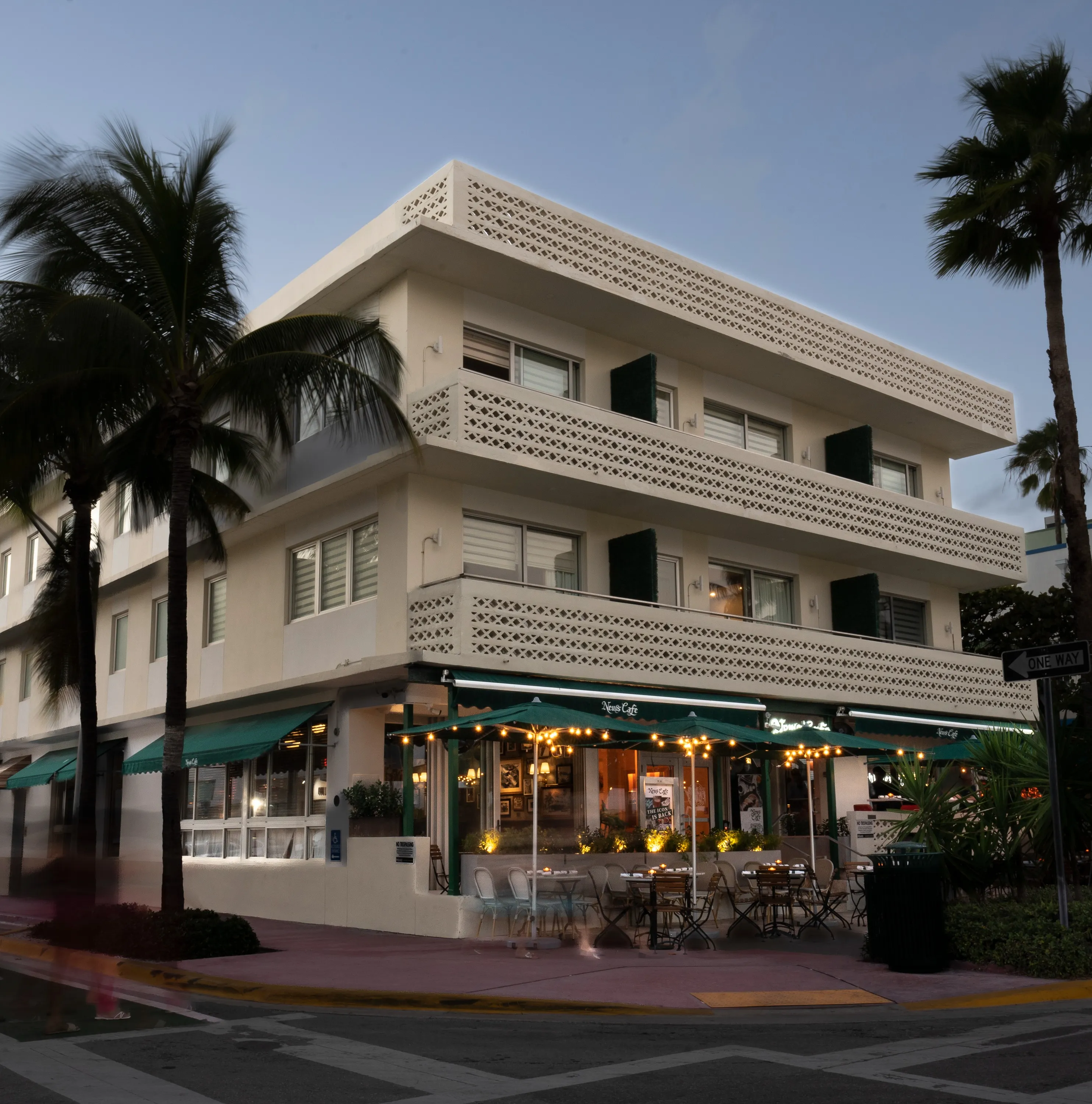


Top: Left: The Hotel, formerly the Tiffany, 1939, L. Murray Dixon, Right: News Cafe, Bottom: Left: Delano Hotel, 1947, B. Robert Swartburg, entrance, Right: Delano Hotel, 1947, B. Robert Swartburg, beach club
What makes the Art Deco Historic District worth understanding, beyond the postcard version, is how completely local circumstance reshaped an international style. Art Deco could have arrived in Miami Beach and looked exactly as it did everywhere else: dark, vertical, and formal. Instead, a small group of architects working within real constraints, tight budgets, a hurricane-prone climate, a clientele of middle-class vacationers rather than industrial magnates, bent the style toward something warmer, lower to the ground, and entirely their own. The preservation campaign that followed did something similar on a larger scale. Capitman and Horowitz did not simply save one neighborhood; the model they built, treating recent, unglamorous, still-inhabited architecture as worth documenting and defending, helped inspire Art Deco societies in cities across the country and eventually a World Congress on Art Deco that now meets in a different country every two years.
A style born in Paris in 1925, adapted to a swampy barrier island a decade later, nearly lost to neglect, and then rescued by a handful of determined residents, is a distinctly American arc, as much as anything built along Ocean Drive. Millions of visitors walk that street every year mostly for the sunshine and the photographs, with little reason to think about the hurricane that preceded these buildings, the depression that shaped their budgets, or the fight that saved them from demolition. None of that history is necessary to enjoy an afternoon on the beach. But it is there anyway, in the eyebrow shading a café table, the terrazzo underfoot, and the porthole window catching the last of the light, for anyone who wants to look a little closer.
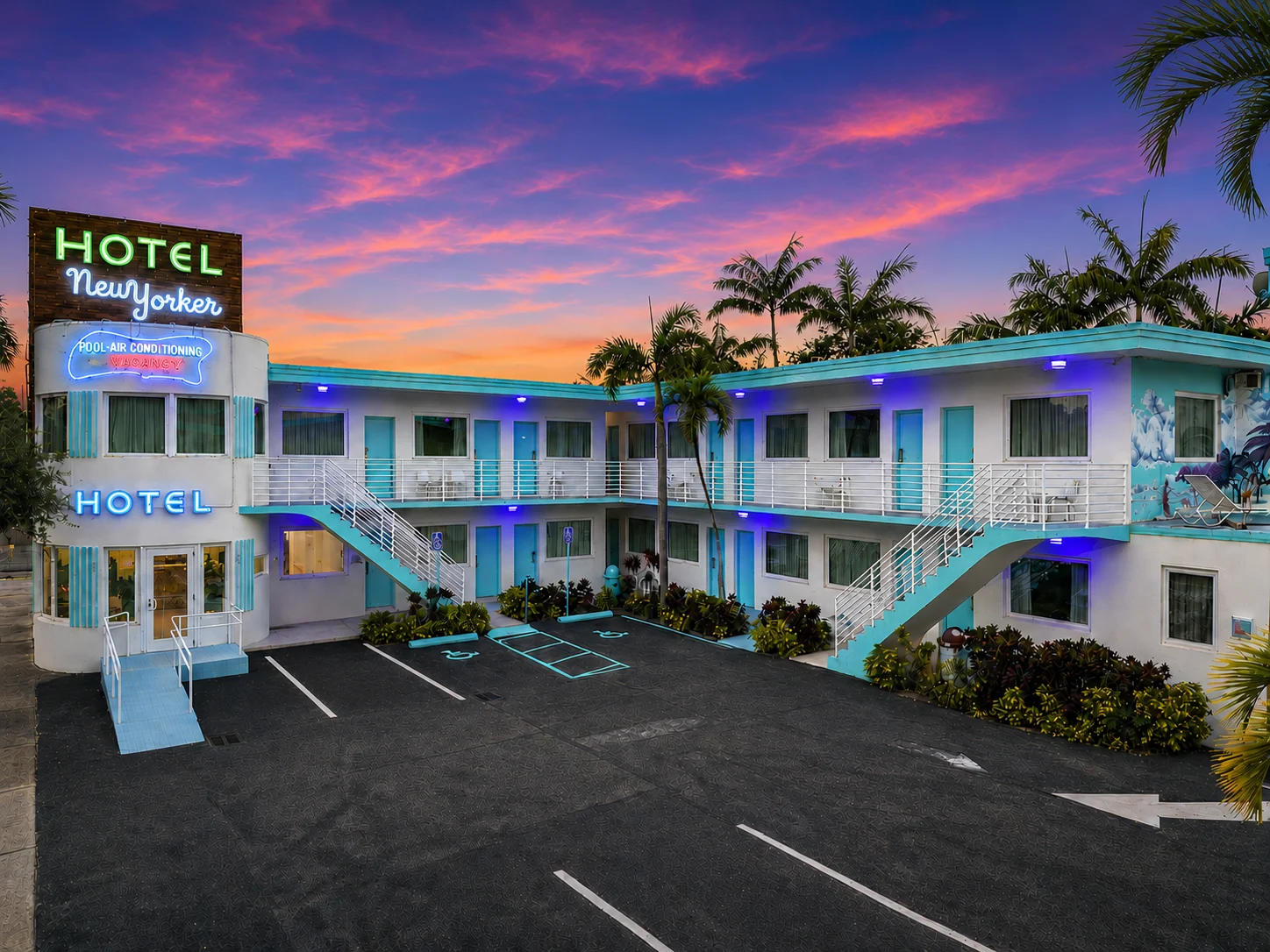
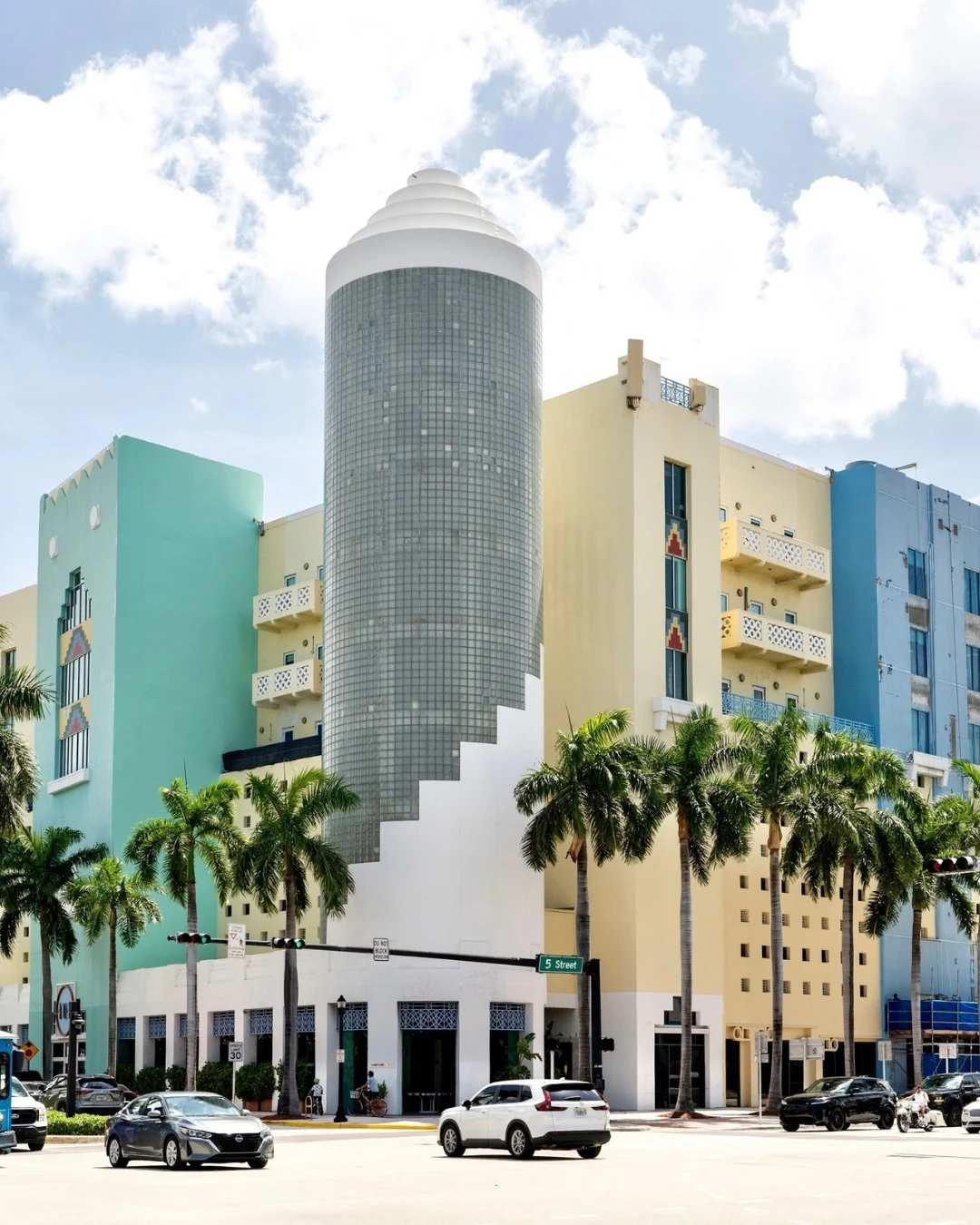
Left: The New Yorker, 1953, Norman Giller, Biscayne Boulevard, Miami, Right: 404 Washington Avenue, Miami Beach
Further Reading
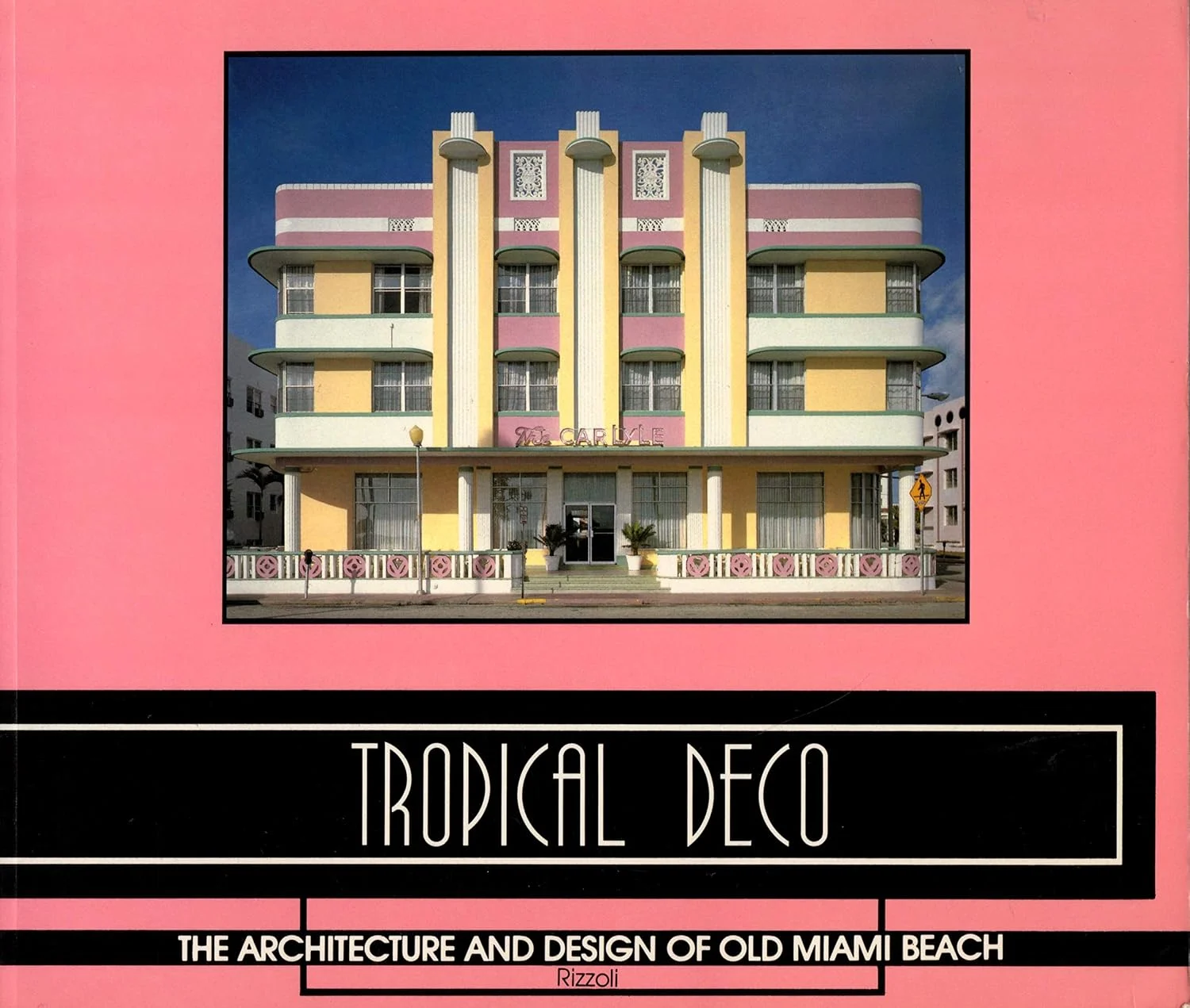
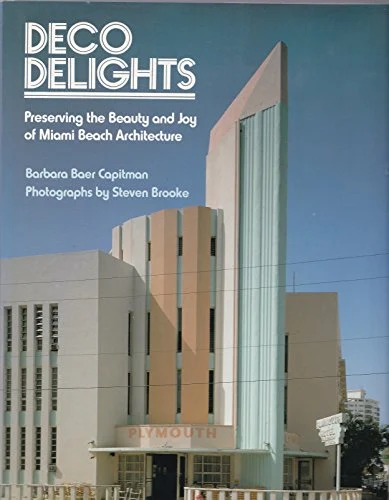
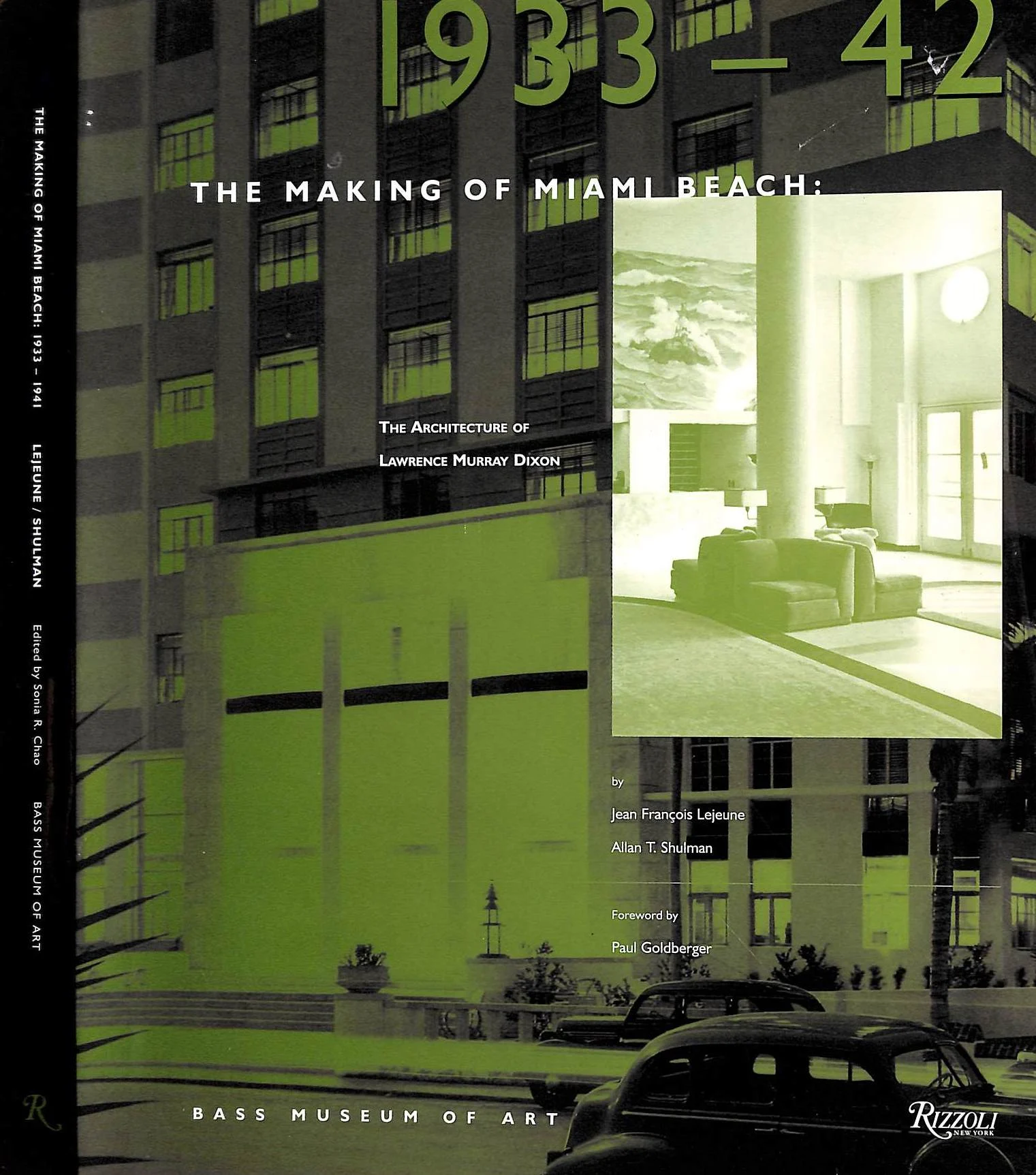
Readers who want to go deeper than a single article have several solid places to start. Laura Cerwinske’s Tropical Deco: The Architecture and Design of Old Miami Beach, published in 1981 with photography by David Kaminsky, remains one of the earliest and most evocative studies of the district, written just as the preservation fight was gaining momentum and the neighborhood’s revival was still uncertain. Barbara Baer Capitman’s own Deco Delights: Preserving the Beauty and Joy of Miami Beach Architecture, published in 1988, offers a firsthand account from the woman most responsible for the district’s survival, part history and part personal chronicle of the campaign to save it. For a closer look at one of the two architects most associated with the neighborhood, Jean-François Lejeune and Allan T. Shulman’s The Making of Miami Beach, 1933-1942: The Architecture of Lawrence Murray Dixon traces Dixon’s prolific decade of work in careful detail. And for anyone planning an actual visit, the Miami Design Preservation League, the organization Capitman and Horowitz founded in 1976, still runs daily walking tours and a small museum on Ocean Drive, offering the most direct way to experience this history in person rather than reading about it secondhand.
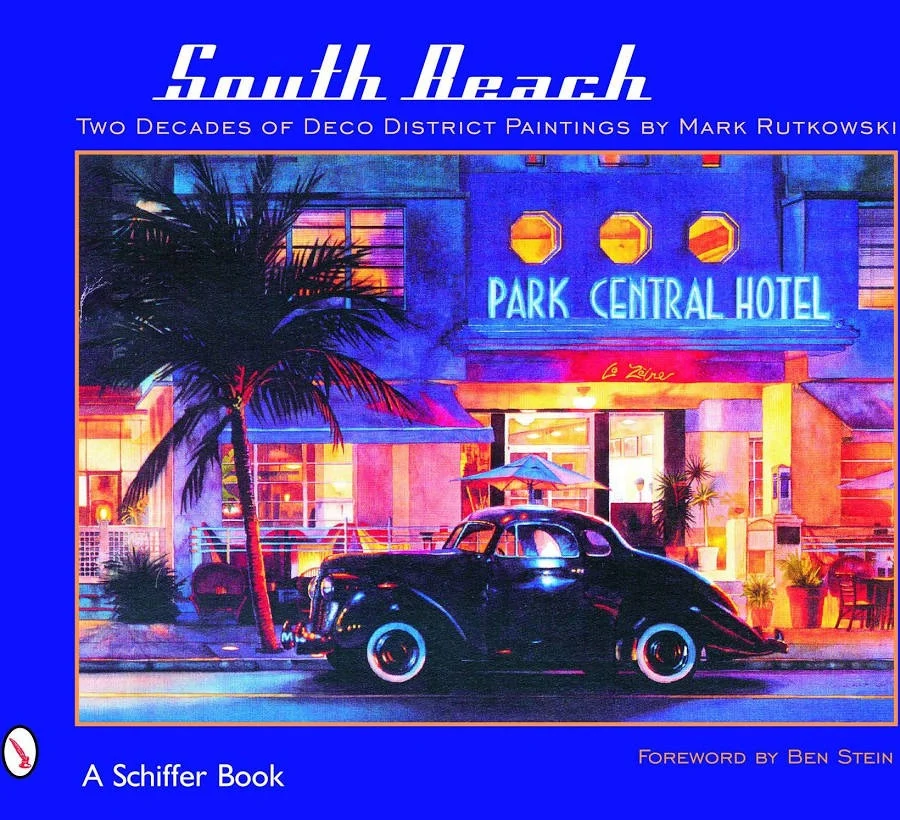
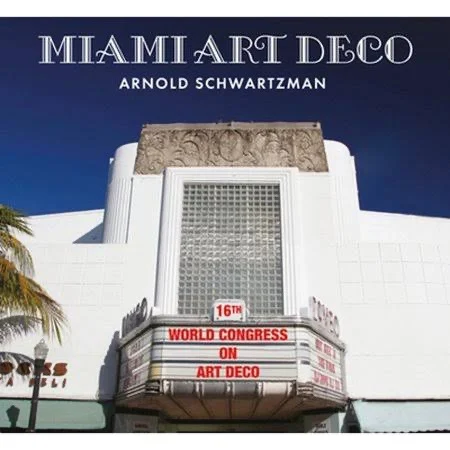
If you are interested in further stories of Art Deco design, collecting, and celebrating the artistry of early 20th Century:

Related Products from ArtDecoCollection.com
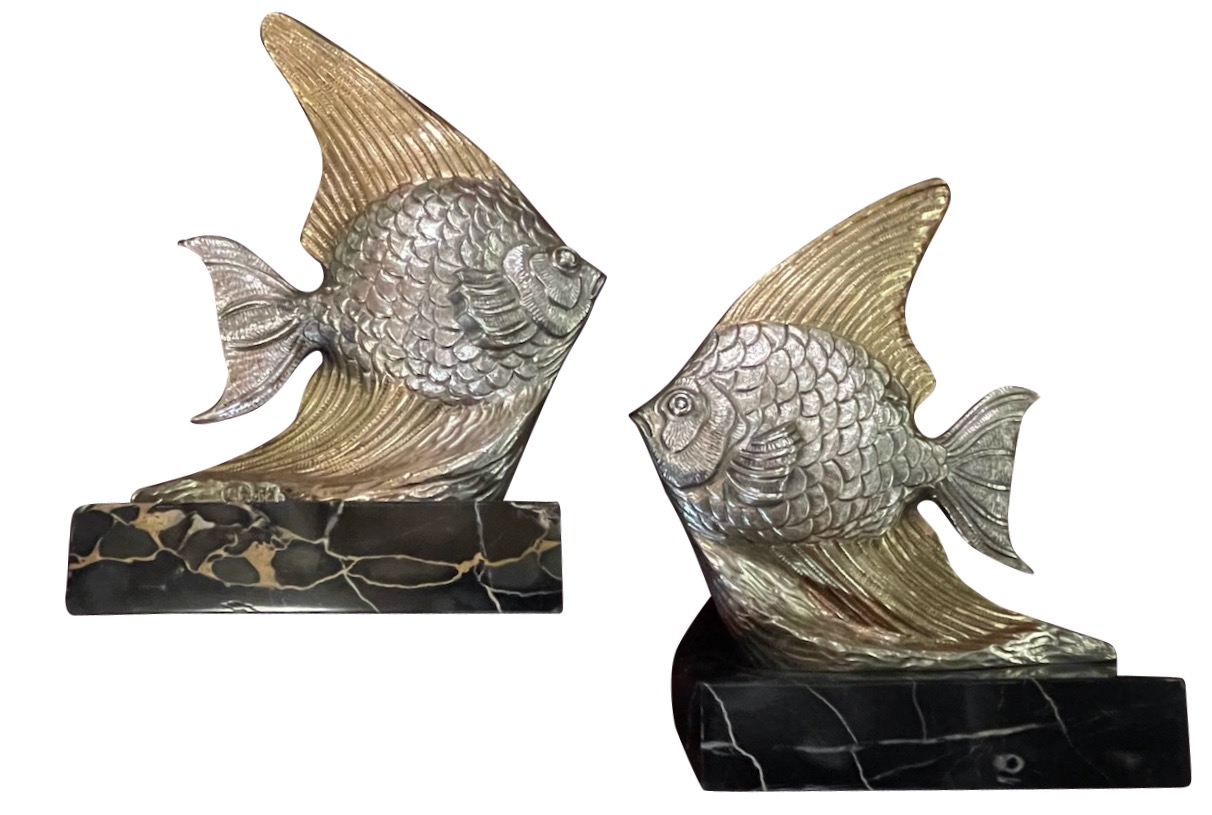
Art Deco Silver and Gold Tropical Fish Bookends on Marble Bases
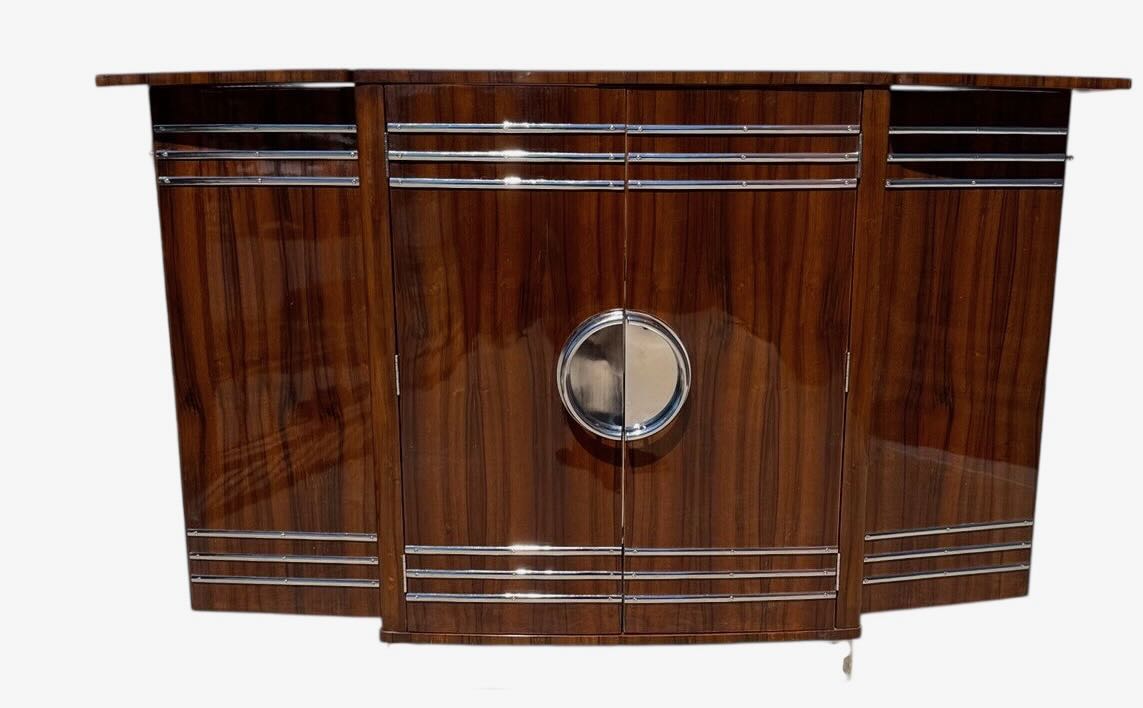
English Art Deco Yacht Flip Top Bar in Flamed Walnut
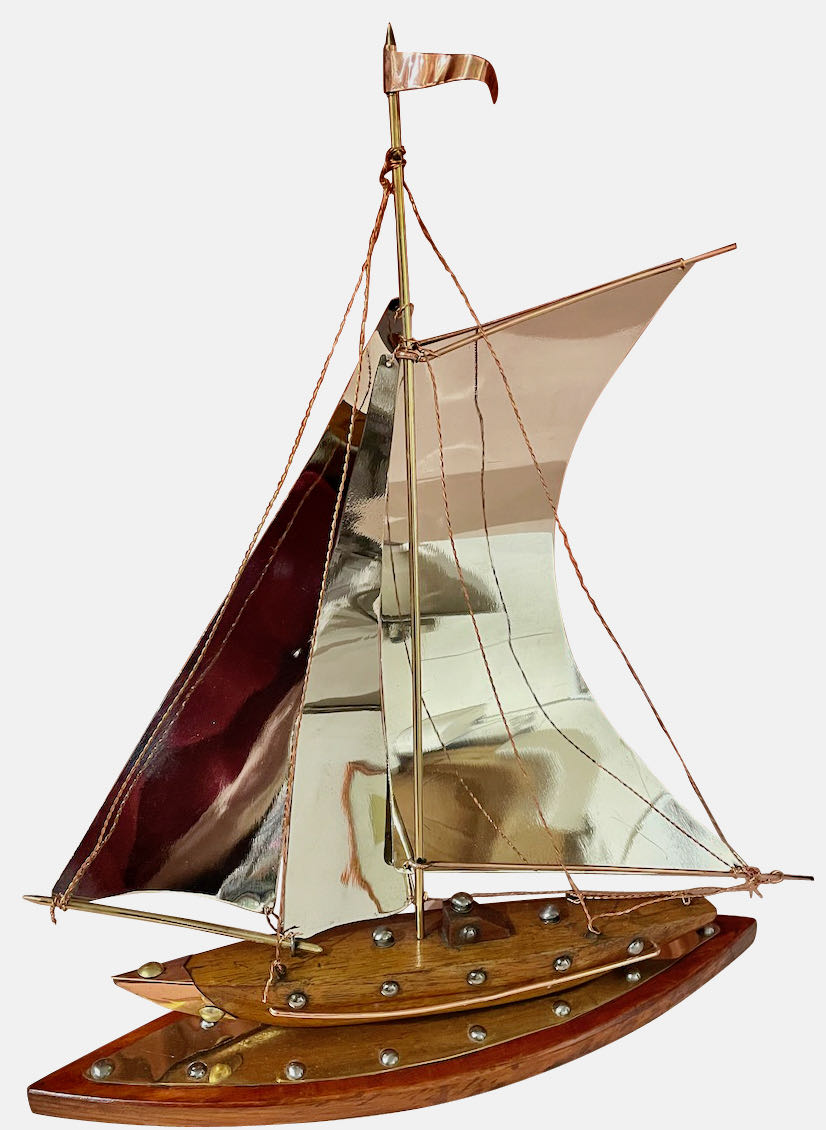
Copper, Chrome, Brass and Wooden Sailing Boat Sculpture
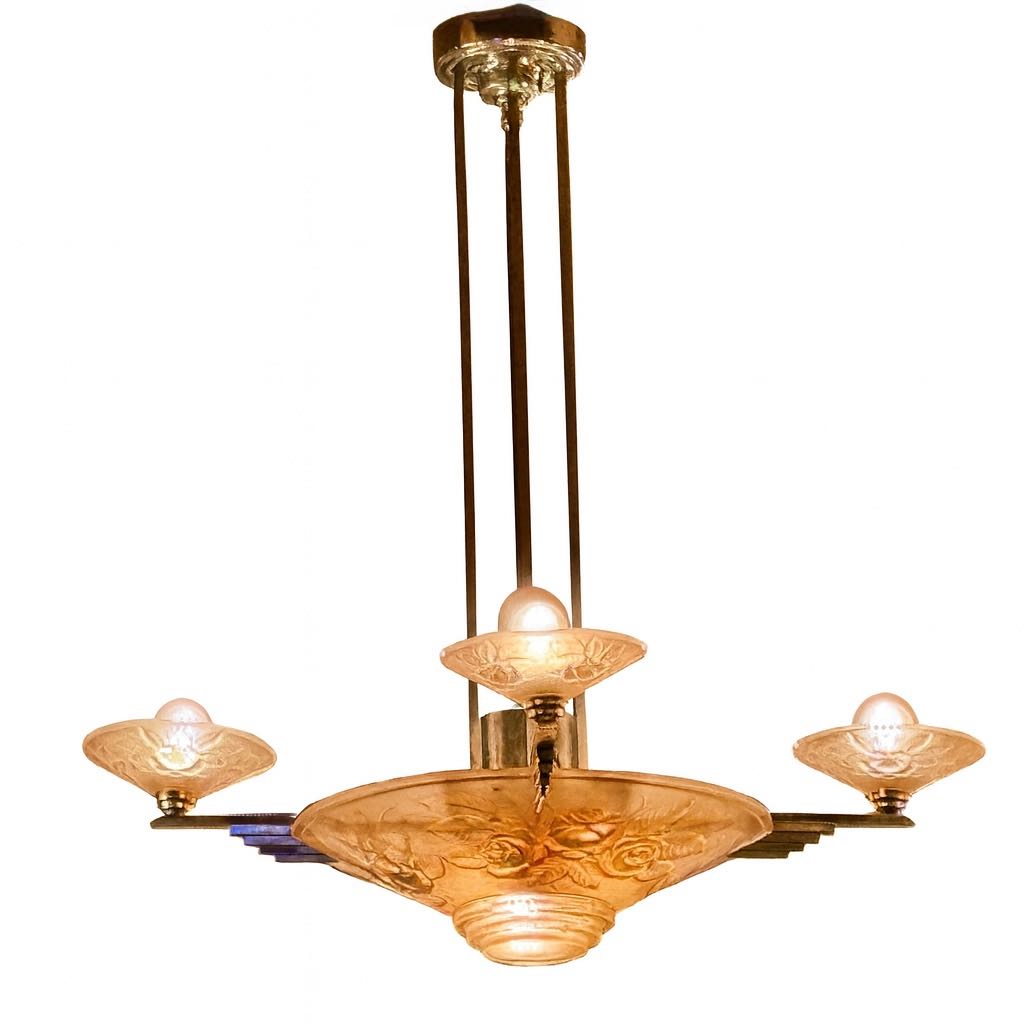
French Art Deco Chandelier by Muller Frères, Luneville
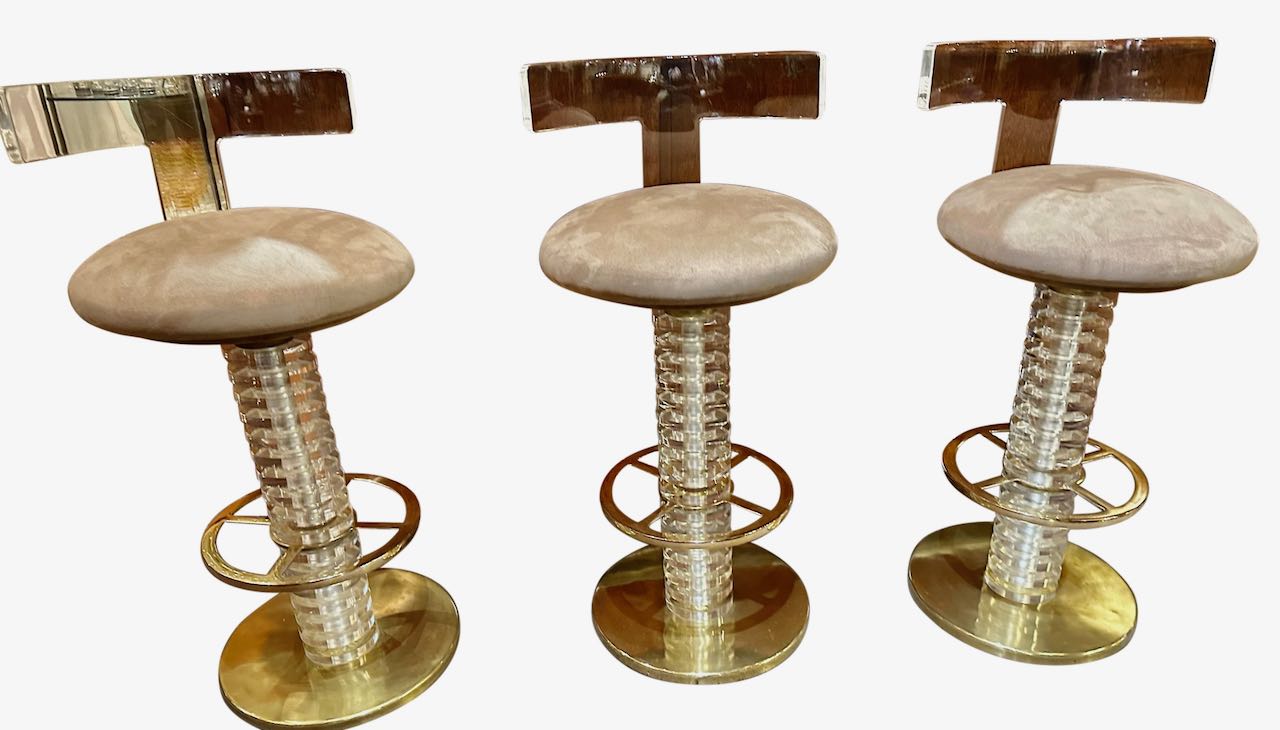
Vintage Bar Stools Lucite and Brass Art Deco Mid Century Style
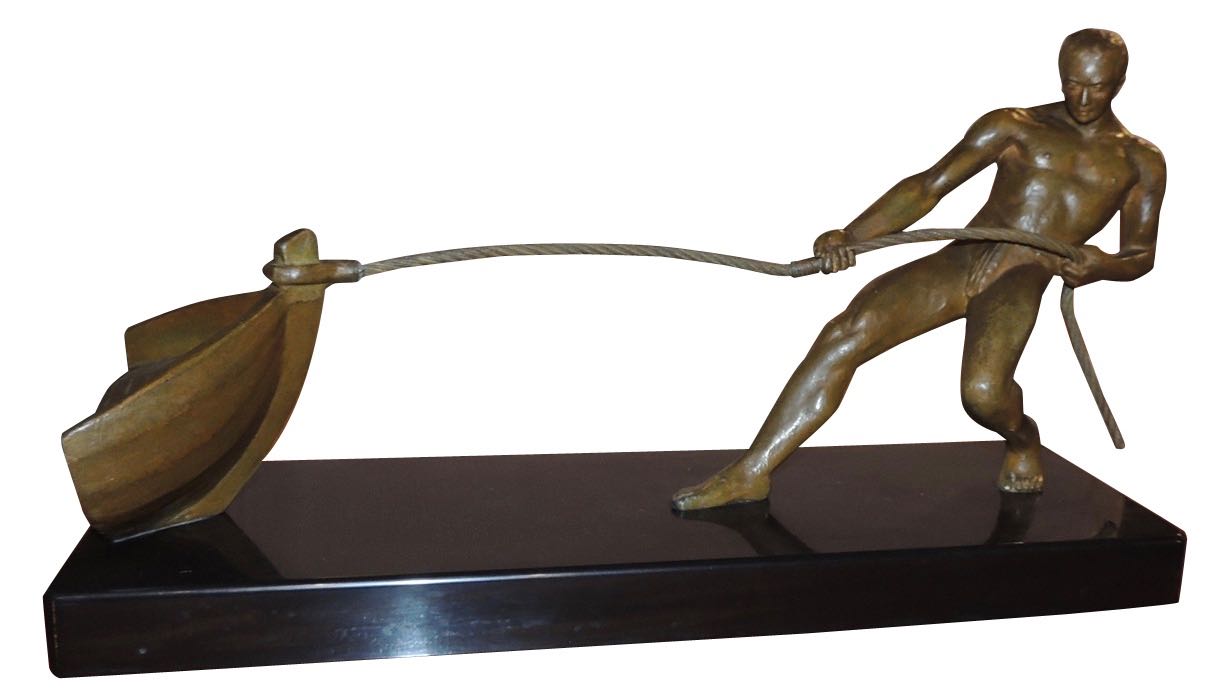
Art Deco Bronze Statue of Man Pulling Boat
Karl Hagenauer Chrome Sailboat Sculpture – Vienna Art Deco, c. 1928

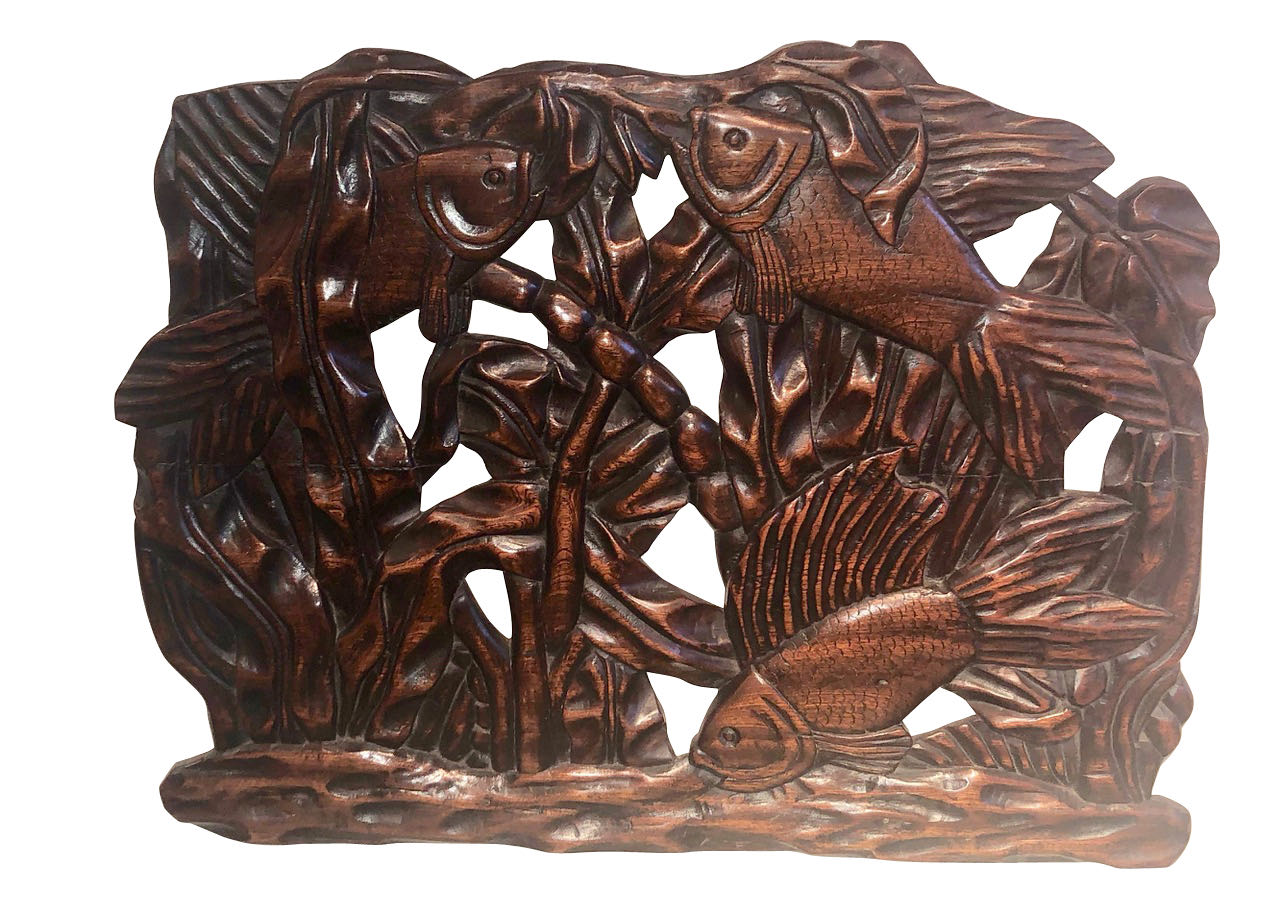
Belgian Art Deco Carved Wood Fish Relief Sculpture
ART & STATUES
CERAMICS & GLASS
© Copyright Art Deco Collection. 2026 All rights reserved. Site Map